Column
Hydraulic Pump Repair: Costs, Common Failure Causes, and Contractor Selection Guide
Have you ever been unsure how to deal with a problem in the hydraulic system of construction machinery or other equipment operating on site?
If a pump malfunction is left unattended, surrounding components may also be damaged, potentially leading to major repairs.
In this article, we explain the symptoms that suggest a hydraulic pump failure and the specific steps for dealing with it.
We also summarize typical repair cost ranges and how to identify a specialist contractor you can trust.
With the right knowledge, you can minimize machine downtime and help maintain stable site operations.
What Happens When a Hydraulic Pump Fails?
When an abnormality occurs in the pump, it can affect work across the entire site.
If signs of trouble are detected early, the damage can be minimized.
Below are four major symptoms.
- Pressure does not rise
- Hydraulic fluid leaks
- Unusual noises occur
- The pump body overheats
If you notice any of these signs, stop the machine immediately and inspect it.
Related Articles:Hydraulic Pump Failure: Common Causes, Symptoms, and Troubleshooting Tips
Pressure Does Not Build Up
If a hydraulic excavator lacks power and cannot lift heavy loads of soil, insufficient hydraulic pressure may be the cause.
Slow boom or swing movement, on the other hand, may indicate insufficient hydraulic oil flow from the pump.
If all functions, including travel, are affected, check the pump and the shared hydraulic circuits.
Wear inside the pump is not the only possible cause.
An incorrectly set relief valve or a malfunctioning control valve can produce the same symptoms.
If only one function is affected, also inspect the associated valves, cylinders, and motors, and use pressure and flow measurements to isolate the cause.
Oil Leaks
When checking for hydraulic oil leaks, inspect the pump itself and the surrounding piping separately.
On the pump, the main inspection points are the shaft seal and the joints in the pump housing.
In the piping system, leaks may occur at fitting connections or from hydraulic hoses.
Leaving oil leaks unaddressed can cause the hydraulic oil level to drop, resulting in inadequate pump lubrication and increased oil temperature.
However, high-pressure oil can cause serious injury if it penetrates the skin, so never use your hands or a cloth to locate a leak.
Stop the machine, lower the work equipment to a safe position, and release any residual hydraulic pressure according to the operator’s manual.
Then have a maintenance technician identify the location and cause of the leak.
Unusual Noises
If unusual noises occur, narrow down the cause by noting the type of sound and when it occurs. Common causes include:
- Internal pump wear
- Bearing damage
- Coupling misalignment
- Problems on the suction side
Aeration occurs when air is drawn in through pipe connections or other points, causing the hydraulic oil to foam and leading to vibration and erratic operation.
Cavitation occurs when suction pressure drops due to a clogged filter, a low oil level, or similar issues, causing bubbles to form in the hydraulic oil and then collapse.
Both conditions can damage internal components, so stop operating the machine and have it inspected if unusual noises occur.
The Pump Body Overheats
If the pump body or piping feels abnormally hot to the touch, the pump may no longer be cooling or lubricating properly.
If the amount of hydraulic fluid is low, or if the fluid has aged and lost viscosity, frictional heat can no longer be adequately controlled.
The temperature will also rise rapidly if the machine continues to be operated above its specified load.
If the oil temperature becomes too high, it accelerates deterioration of packings and seals, creating a vicious cycle that leads to even more leakage.
If you notice abnormal readings on the temperature gauge or a burnt smell, move the machine to a safe place immediately and allow sufficient time for cooling.
Hydraulic Pump Repair Methods and Workflow
Once the cause of the malfunction has been identified, repair work should proceed in the proper order.
After ensuring safety, the appropriate action must be taken based on the condition of the machine.
Below are four steps in the repair process.
- Ensure safety before starting work and isolate the power source (lockout)
- Cases where replacing parts is sufficient
- Complete disassembly and reconditioning (overhaul)
- Air bleeding procedure, which is essential after repair
Following the correct procedure at each stage is essential to returning the machine to service.
Ensure Safety Before Starting Work and Isolate the Power Source (Lockout)
Before beginning work, safety measures to prevent unexpected machine movement are essential.
Stop the engine, remove the key, and keep it under the control of the person performing the work.
In addition, disconnect the battery wiring to completely cut off the power source, and apply a lock and warning tag so that no third party can restart the machine (lockout/tagout).
Because high pressure often remains inside the hydraulic circuit, you must also carefully relieve pressure through the appropriate valve.
If a hose is removed while residual pressure remains, oil may spray out forcefully and cause a serious accident.
Only begin the actual removal work after creating a safe working environment.
When Replacing Parts Is Sufficient
If an oil leak is caused solely by external seals, O-rings, or similar components, and the pump’s major internal components are in good condition, the issue can be resolved by replacing the affected parts.
If these parts can be replaced without disassembling the pump, the repair may take less time and cost less than an overhaul.
Do not replace proportional pressure-reducing valves or regulators based on symptoms alone.
Measure pressure and flow, and, for electrically controlled systems, also check the wiring and control signals.
Replace a component only after confirming that it is faulty.
After completing the repair, check for oil leaks and perform a test run to verify that pressure and operating speeds have returned to the specified values. Record the measurement results as well.
Complete Disassembly and Reconditioning (Overhaul)
If internal wear or damage is confirmed, remove the hydraulic pump for an overhaul. The main steps are:
- Disassembly
- Cleaning
- Dimensional measurement
- Replacement of damaged components
- Reassembly and adjustment
- Performance testing
Use the measurement results to determine which parts need replacing and which can be reused.
Before commissioning an overhaul, check the service provider’s ability to source genuine parts, the testing facilities available, and the warranty coverage provided after the repair.
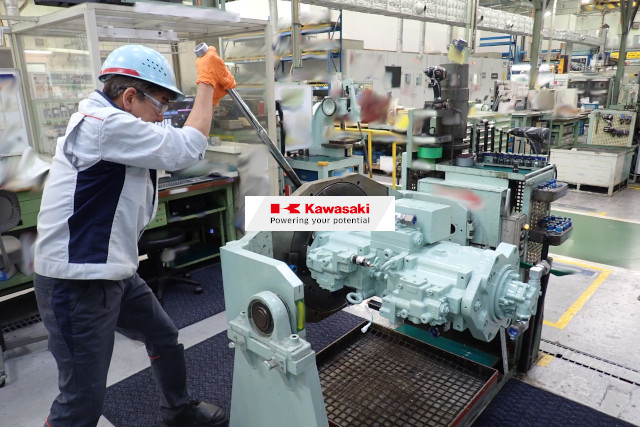
At Kawasaki Heavy Industries’ service centers, pumps are disassembled and inspected before being reassembled and subjected to dynamic testing to verify their performance.
Essential Air Bleeding Procedure After Repair
After reassembly and installation on the machine, be sure to bleed air from the circuit.
If the machine is operated with air remaining inside, cavitation will occur and may damage the newly repaired parts again.
Before starting the engine, be sure to fill the pump case with hydraulic fluid and loosen the air-bleed plug on the top of the unit to expel the air inside.
If the engine is run while air remains inside, internal parts can seize almost instantly.
After confirming that all bubbles have completely disappeared, retighten the plug. Then run the engine at low speed and slowly operate each cylinder to push the remaining air out of the entire circuit.
If the oil level drops, add more as needed. Once abnormal noise has completely disappeared and the system moves smoothly, the work is complete.
Should You Choose Repair or Replacement?
When the pump is nearing the end of its service life, you need to take a long-term view and choose the most cost-effective option.
Below are three decision criteria.
- Use the serial number on the nameplate to identify accurate information
- Cases where repair is suitable
- Cases where replacement should be considered
Compare these criteria with the current condition of your machine to determine the best course of action.
Identify Accurate Information from the Serial Number on the Nameplate
Before making a decision, first check the nameplate attached to the pump body.
By reading the information engraved on it, you can identify the manufacturer, exact model, and product number.
Even among machines of the same type, it is not uncommon for different hydraulic systems to be installed depending on the production period.
If you contact the manufacturer using the information from the nameplate, you can confirm whether replacement pumps or repair parts for that specific model are still being supplied.
If repair parts are available, repair remains an option. If production has already ended, you may need to consider replacing the entire unit.
When Repair Is Appropriate
An overhaul is a suitable option when the pump’s major components can be reused and replacing damaged parts is expected to restore performance. When deciding whether to proceed, check that the following conditions are met:
- The housing can be reused.
- The necessary replacement parts can be sourced.
- Performance testing can be carried out after the repair.
- The repair costs less than replacing the pump.
Depending on the extent of internal damage, replacing wear items such as seals may not be enough to restore adequate performance. Do not base the decision solely on symptoms observed before disassembly. Measure component dimensions and inspect for damage to determine which parts can be reused and which need to be replaced. Use the inspection results to confirm whether repair is feasible and how much it will cost.
When Replacement Is the Better Option
If the metal parts inside the pump have seized extensively, replacement is more reliable than repair.
Replacement should also be considered when deterioration has progressed throughout the unit after long-term use and the manufacturer no longer supplies parts.
Even if you force a repair using similar parts, another part may fail soon afterward, prolonging downtime.
Replacing the unit with a new one provides the benefit of higher durability through updated design, which can ultimately reduce long-term maintenance costs.
Related Articles:Hydraulic Pump Replacement Guide: Cost, Timing, Procedures, and Maintenance Tips
Estimated Costs for Hydraulic Pump Repair
The actual cost charged by a contractor varies depending on the size of the machine and the severity of the failure.
| Repair item | Estimated cost |
|---|---|
| Hydraulic hose replacement | Approx. JPY 10,000 to 30,000 per hose (USD 60 to 190) |
| Packing replacement and oil leak repair | Approx. JPY 50,000 to 150,000 (USD 310 to 940) |
| Hydraulic pump body repair (partial repair) | Approx. JPY 100,000 to 300,000 (USD 630 to 1,880) |
| Complete overhaul (replacement of internal components) | Approx. JPY 300,000 and up (USD 1,880 and up) |
| Replacement with a new unit | Varies greatly depending on the machine model |
Note: USD equivalents are rough estimates for reference only and may vary depending on the exchange rate at the time of quotation.
For on-site service, additional travel charges may apply, so obtain a quote in advance and compare the breakdown.
The above figures are only general estimates and will vary depending on the machine size and the extent of the damage.
Related Articles:Hydraulic Pump Repair Cost: Typical Prices for Excavators and Construction Machinery
Main Factors Affecting Repair Costs
Even when the symptoms are the same, hydraulic pump repair costs vary depending on the machine and the nature of the fault. The main factors include:
- Size of the construction equipment
- Hydraulic pump model
- Extent of damage to internal components
- Parts availability
- Need for reconditioning work
- Whether repairs are carried out on-site or in a workshop
Large machines and pumps with complex designs tend to incur higher costs—not only for parts but also for pump removal, reinstallation, and transport.
Costs also increase when internal damage is extensive or replacement parts cannot be sourced promptly.
If worn components require reconditioning, such as grinding, the additional work may also extend the repair turnaround time.
Costs differ between repairs completed on-site and those that require the pump to be removed and transported to a workshop.
If metal particles are found in the hydraulic oil, the repair often includes flushing the hydraulic circuit and replacing filters to prevent secondary damage to other components.
Breakdown of Costs in a Repair Estimate
Hydraulic pump repair costs are not determined by replacement parts alone. Check whether the estimate includes the following:
- Fault diagnosis
- Pump removal and reinstallation
- Disassembly and inspection
- Cleaning
- Replacement parts
- Reconditioning work
- Reassembly and adjustment
- Performance testing
- Technician travel charges and pump transport costs
Because the pump’s internal condition cannot be assessed until it is disassembled, the initial estimate may differ from the formal quote issued after disassembly.
Confirm that, if additional damage is found, the service provider will inform you of the revised cost and turnaround time before continuing the work.
If you decide not to proceed with the repair after disassembly, you may still be charged for inspection and return shipping.
Before commissioning the repair, clarify which costs you will be responsible for, including any disposal fees if the pump cannot be repaired.
When comparing estimates, look beyond the total price and review the cost of each item of work.
How to Choose a Reliable Hydraulic Pump Repair Contractor
Choosing a contractor with the right expertise is a key factor in extending the service life of your machine.
If you choose based on price alone, it may lead to trouble later.
Three criteria can help you identify a contractor you can trust.
- Check technical capability and track record
- Check service area and whether on-site repair is available
- Check whether the company is a certified service center that can source genuine parts and provide official warranty coverage, helping you avoid the risks of non-genuine parts
Finding a contractor that meets these conditions will help you achieve a high-quality repair outcome.
Check Technical Capability and Track Record
Hydraulic systems are complex, and even slight clearances or assembly errors can cause serious problems.
For that reason, it is essential to choose a company with extensive experience repairing a wide range of hydraulic equipment over many years.
Review case studies posted on the company’s official website and confirm whether they are familiar with machines from the same manufacturer as yours.
You can feel more secure if the company has technicians who thoroughly understand a wide range of models rather than being narrowly focused on a single manufacturer.
When you contact them in advance, a representative who can accurately identify likely causes from the symptoms and explain them clearly is a good sign that the contractor is reliable.
Check the Service Area and Whether On-Site Repair Is Available
Because construction machinery and industrial equipment cannot be moved easily, whether the contractor can come directly to your site is an important factor.
If the distance from the contractor’s office to the site is long, it will take more time for them to arrive and may also result in high travel charges.
First, confirm that your site is within the contractor’s service area.
It is also important to know whether they can respond flexibly—whether the problem can be fixed on site with a simple parts replacement or whether the unit must be removed and taken back to the factory.
Check Whether the Company Is a Certified Service Center That Uses Genuine Parts
The most important point is to avoid contractors who use cheap third-party products, counterfeit parts, or imitation parts in order to reduce costs.
Non-genuine parts often do not match the original design tolerances, which creates the risk of another failure in a short time, prolonging downtime and ultimately increasing lifecycle costs.
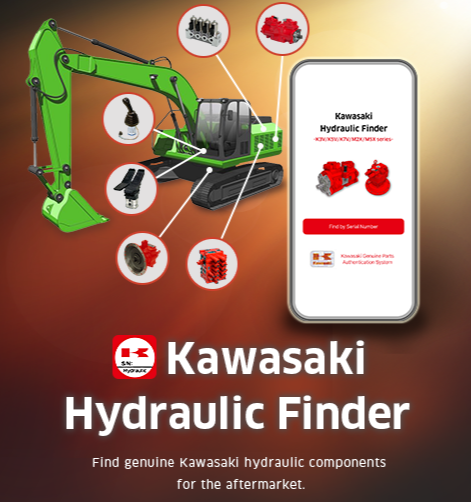
To prevent this, it is effective to use an app such as the “Kawasaki Hydraulic Finder,” which helps identify the correct genuine parts from the serial number on the nameplate.
Then, to reduce the risk of repeat failure, request repairs from a certified service center (authorized dealer) that can repair the unit using genuine parts.
Check How Genuine Parts Are Sourced and Review the Post-Repair Warranty
Parts used in repairs fall into different categories based on their manufacturer and condition.
- Genuine parts: Parts produced to the manufacturer’s specifications and quality standards
- Aftermarket replacement parts: Compatible parts made by manufacturers other than the original equipment manufacturer
- Used parts: Previously used parts that are generally reused as they are
- Reconditioned parts: Previously used parts that have been disassembled and serviced for reuse
- Counterfeit parts: Parts that may be passed off as genuine
The quality of aftermarket replacement parts and reconditioned parts varies.
Check the manufacturer and reconditioning process. When comparing options, confirm whether performance testing has been carried out and review the warranty coverage.
Also check the estimate to confirm which category of parts will be used and the warranty period.
Kawasaki Hydraulic Finder is a tool that allows you to check the authenticity of supported Kawasaki hydraulic equipment using its serial number.
You can then use the results when consulting an authorized sales representative about sourcing genuine parts.
Process for Requesting Hydraulic Pump Repair
First, provide the current symptoms, hydraulic pump model, and serial number by phone or other means.
After that, a representative visits the site, inspects the actual machine, diagnoses the cause, and submits a quotation.
If you are satisfied with the proposed cost and timeframe, a formal contract is signed and the work begins.
Repairs that can be handled on-site are carried out immediately, but if disassembly is required, the unit is often taken back to the factory.
After all work is completed, the contractor performs a final test run with the customer present to check for oil leaks or unusual noises, and then the machine is handed back.
Summary: Early Action and the Right Contractor Can Help Control Repair Costs
Hydraulic pump failures—such as pressure loss, oil leaks, unusual noise, and overheating—can often be resolved with less extensive and less expensive repairs if addressed early rather than left unattended.
Whether you should repair or replace the unit should be decided by comparing the cost of an overhaul with the cost of purchasing a new unit, and contractors should be chosen based on technical capability and their ability to procure genuine parts.
Kawasaki Heavy Industries provides the “Kawasaki Hydraulic Finder,” which allows users to identify genuine parts and confirm accurate information from the serial number on a hydraulic pump nameplate.
The identified part information can then be used directly to make inquiries or place orders with official OEM dealers and Kawasaki-certified service centers.
If you are looking for a repair provider or considering procurement of genuine parts, it can be a useful resource.
Reviewed by

Ryoji Irie
Manager
After-Sales Promotion Office, Marketing & Sales Group, Precision Machinery & Robot Company, Kawasaki Heavy Industries, Ltd.
《Career History》
After joining Kawasaki Heavy Industries, I spent ten years developing the new K7V pump series as a design engineer, followed by five years at KPM (UK) as an application engineer supporting European OEMs and distributors. I am currently responsible for promoting the after-sales business globally.