Column
Parts of an Excavator: Main Components, Structure, and Genuine Parts Guide
When heavy machinery used every day on construction sites develops a fault, it can disrupt the progress of the
work.
Problems in the hydraulic system are often difficult to diagnose, and it is not uncommon to be unsure how best to
handle repairs or parts replacement.
This article explains the basic structure of a hydraulic excavator and the role of each of its major components.
It also outlines how the hydraulic circuit works, including the hydraulic pump, and explains how to select and order
the genuine parts needed for repairs.
Use this guide to deepen your understanding of how the machine works and as a reference for proper maintenance and
parts procurement.
The Three Main Sections of a Hydraulic Excavator
A hydraulic excavator can be divided into three main sections.
These sections work together to perform complex tasks such as excavation smoothly and efficiently.
- The upperstructure, which contains the engine and operator’s cab
- The undercarriage, which moves the machine
- The front attachment, which performs digging work
Understanding the role of each section will help you grasp the overall structure of the machine.
Related Articles:Excavator Repair Guide: Common Problems, Causes, and Solutions
The Upperstructure, Which Contains the Engine and Operator’s Cab
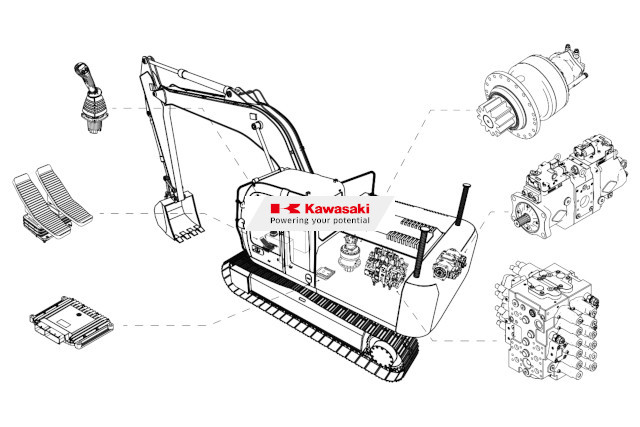
The upperstructure is the part of the machine that houses the engine, which generates power, and the operator’s
cab.
Located above the undercarriage, it is designed to rotate freely through 360 degrees on a swing bearing.
Inside, it contains components such as the hydraulic pump and the control valve, which regulates the flow of hydraulic
fluid.
At the rear, a heavy counterweight is fitted to balance the machine.
This counterweight prevents the machine from tipping forward when it lifts soil or other material.
It is essentially the machine’s operational core.
Related Articles:Hydraulic Pump Components Guide: Main Parts, Functions, and Failure Response
The Undercarriage: Moving the Machine
The undercarriage supports the machine and enables it to move. Hydraulic excavators come in tracked and wheeled configurations.
Tracked undercarriages have a large ground contact area, helping the machine remain stable on uneven terrain and soft ground.
Wheeled excavators travel on tires, making them well suited to moving on paved surfaces.
A tracked undercarriage consists of drive sprockets, idlers, and tracks. It also has upper and lower rollers that support the tracks.
Controlling the left and right travel motors allows the machine to move forward, reverse, and turn. Remove any mud or stones lodged in the undercarriage, and regularly check the track tension and inspect the rollers for wear.
Related Articles:Hydraulic Motor Maintenance: Best Practices, Warning Signs, and Maintenance Procedures
The Front Attachment, Which Performs Digging Work
The front attachment is the section that performs the actual digging and loading work.
It mainly consists of the boom connected to the machine body, the arm attached to the boom, and the bucket at the tip
that scoops up soil.
These components are connected by pins like joints, and the hydraulic cylinders mounted at each point extend and
retract to create complex movements.
Another key feature is its versatility: by changing the tool at the end, the machine can handle a wide range of tasks,
such as breaking concrete or gripping timber.
This is essentially the excavator’s arm, allowing it to adapt flexibly to conditions on site.
Regular greasing is essential to keep it moving smoothly.
How the Hydraulic Circuit and Pump Power the Excavator’s Components
A hydraulic excavator operates by circulating hydraulic oil from the pump to its various components. The main components of the hydraulic circuit are:
- A hydraulic pump that supplies hydraulic oil
- A control valve that regulates the flow of hydraulic oil
- A swing motor and swivel joint that enable the upper structure to rotate
- Hydraulic cylinders and motors that produce linear and rotary motion
- A tank, piping, and filters through which hydraulic oil circulates
Let’s look at the role of each component and how they are connected within the hydraulic circuit.
Related Articles:Excavator Hydraulic Pump Guide: How It Works, Warning Signs, and Repair Costs
The Hydraulic Pump, Which Converts Engine Power into Hydraulic Energy
The hydraulic pump is the component that converts the engine’s mechanical rotational force into hydraulic energy in
the form of pressurized fluid.
Like the heart in the human body, it pumps hydraulic fluid throughout the machine.
Modern hydraulic excavators mainly use variable displacement pumps, which can flexibly adjust the volume of fluid they
deliver.
Because they can automatically adjust flow and pressure according to the working load, these pumps allow the machine
to operate efficiently while reducing unnecessary fuel consumption.
If the pump develops a problem, the entire machine becomes sluggish, making it one of the most critical components in
the excavator.
The Control Valve, Which Controls the Direction and Flow Rate of Hydraulic Fluid
The control valve distributes the high-pressure hydraulic fluid delivered by the hydraulic pump to the appropriate
locations.
In response to movements of the control levers in the cab, the internal valves shift to precisely regulate the
direction, flow rate, and pressure of the fluid.
Whether the machine raises the boom or swings the upperstructure is determined through this valve.
Multiple valves are integrated into a single block, making it the machine’s “brain” for smooth combined
operations.
If oil leakage or internal wear occurs, the machine may no longer respond as commanded, which is why this is such a
critical component for accurate operation.
The Swing Motor and Swivel Joint That Enable the Upper Structure to Rotate
The swing motor converts the hydraulic energy of oil supplied by the control valve into rotary motion.
This rotation is transmitted through a reduction gearbox and swing gear to turn the upper structure to the left or right.
The swing bearing supports the weight of the upper structure while allowing it to rotate smoothly.
A faulty swing motor can cause reduced swing speed, unusual noises, or oil leaks.
The swivel joint is a rotary coupling located between the upper structure and the undercarriage.
It routes hydraulic oil through internal passages to the left and right travel motors and other components, preventing the hydraulic hoses from twisting as the upper structure rotates.
If the internal seals deteriorate, external oil leaks or internal leakage can develop, resulting in reduced tractive force or uneven travel performance between the left and right sides.
Hydraulic Cylinders and Motors That Produce Linear and Rotary Motion
Hydraulic cylinders and motors convert the energy supplied by hydraulic oil into mechanical motion.
Inside a hydraulic cylinder, oil entering the cylinder barrel pushes the piston, causing the piston rod to extend or retract in a straight line.
The boom cylinder raises and lowers the boom, while the arm and bucket cylinders provide the movements needed for digging.
A hydraulic motor uses the energy of hydraulic oil to rotate its output shaft.
Rotation from the travel motors is transmitted through reduction gearboxes to the undercarriage, moving the machine forward or backward.
The swing motor turns the upper structure to the left or right through a swing reduction gearbox and swing gear.
Cylinder faults often cause oil leaks or unintended lowering of the work equipment. Common symptoms of hydraulic motor faults include reduced rotational speed, insufficient torque, and unusual noises.
Use the type of movement affected to narrow down which components to inspect.
The Tank, Piping, and Filters That Keep Hydraulic Oil Circulating
The hydraulic oil tank stores the oil used in the hydraulic circuit.
It also dissipates heat from oil returning from the circuit and helps air bubbles and contaminants separate from the oil.
Metal pipes and flexible hydraulic hoses connect the tank to the hydraulic components.
The suction filter removes contaminants from the hydraulic oil before it enters the pump.
The return filter filters oil as it flows back to the tank after circulating through the system.
Insufficient or contaminated hydraulic oil can lead to pump suction problems and component wear.
Clogged filters can restrict flow, potentially causing operating problems and increased oil temperatures.
During daily inspections, check the hydraulic oil level and condition, and look for cracked hoses or loose fittings.
Preventing oil leaks and keeping air out of the system help ensure reliable operation of the hydraulic circuit.
Common Problems with Hydraulic Excavator Components
When troubleshooting a hydraulic excavator, use the affected functions and their symptoms to narrow down which components to inspect.
| Symptom | Components to Check |
|---|---|
| All machine functions operate slowly | Hydraulic pump, relief valve, suction filter |
| Only one work function operates poorly | Control valve, hydraulic cylinder |
| The boom or other work equipment drifts downward | Internal cylinder seals, control valve |
| Unusual noises occur during swing operation | Swing motor, reduction gearbox, swing bearing |
| Tractive force is reduced on one side only | Travel motor, swivel joint, control valve |
| Hydraulic oil leaks | Hydraulic hoses, fittings, seals throughout the system |
The same symptom can have several possible causes.
Check the hydraulic oil level and look for contamination, then measure pressure and flow to pinpoint the fault.
How to Select and Order Genuine Parts for Repair or Replacement
As operating hours accumulate, parts eventually need to be replaced because of seal deterioration and motor wear.
Choosing parts that are not the correct fit can lead to secondary failures, so it is important to follow the proper
procurement procedure.
The following four steps will help you arrange the right parts.
- Understand the risks of using low-cost third-party, counterfeit, or imitation parts
- Verify the part using the nameplate serial number rather than the machine model
- Use the manufacturer’s official parts search app or tool
- Identify the required part number and place the order
Let’s go through the process step by step to prevent trouble and restore the machine safely.
Understand the Risks of Using Low-Cost Aftermarket Parts, Counterfeits, and Unauthorized Copies
Parts used in repairs fall into different categories based on their manufacturer and condition. The main differences are as follows:
- Genuine parts: Parts produced to the manufacturer’s specifications and quality standards
- Aftermarket replacement parts: Compatible parts made by manufacturers other than the original equipment manufacturer
- Used parts: Previously used parts that are generally reused as they are
- Reconditioned parts: Previously used parts that have been disassembled, inspected, and serviced for reuse
- Counterfeits and unauthorized copies: Parts passed off as genuine
The quality of aftermarket replacement parts and reconditioned parts varies depending on the manufacturer or the company that reconditioned them.
Do not base your decision on price alone. Check that the parts are compatible with the hydraulic excavator in which they will be used.
It is also important to check the applicable quality standards and whether performance testing has been carried out, and to compare warranty coverage and supplier reliability.
Check the Component’s Nameplate and Serial Number Rather Than Relying on the Machine Model Alone
To identify compatible replacement parts, check both the machine details and the component details. You will need the following information:
- Excavator make and model
- Machine model designation and serial number
- Manufacturer of the component being replaced
- Component model and serial number
- Details of any previous component replacements or modifications
Even within the same machine model, component specifications may vary by production date.
Used machines may also have had their original components replaced with different ones, so do not rely on machine information alone.
Cross-check the information on the component’s nameplate against the maintenance records, and provide accurate details to the dealer or repair service.
Use the Manufacturer’s Official Parts Search App or Tool
Once you have confirmed the serial number on the part’s nameplate, use the official search tool provided by the parts
manufacturer to narrow down the information.
Today, parts lookup systems that can be accessed from a smartphone or computer are widely available.
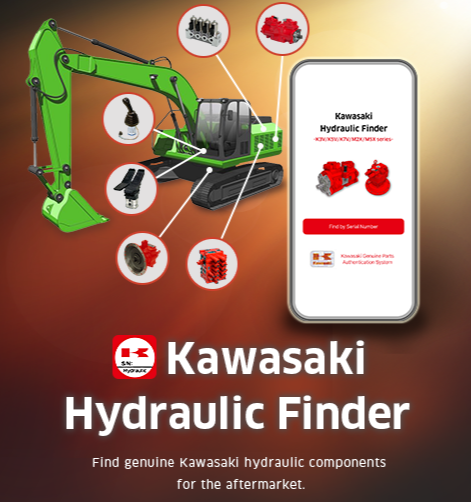
For example, if the machine uses hydraulic equipment from Kawasaki Heavy Industries, the dedicated Kawasaki Hydraulic
Finder is a useful option.
This tool can verify the authenticity of the company’s hydraulic pumps and swing motors used by many construction
equipment manufacturers in Japan and abroad.
By simply entering the serial number from the nameplate, you can confirm whether the unit is genuine and quickly view
detailed information.
Identify the Required Part Number and Place the Order
Based on the results displayed in the search tool, identify the correct part information for the component that needs
to be replaced.
Because the screen shows the exact model code (TYPE) and OEM part number (USE FOR), it helps prevent mistakes such as
ordering a different part that looks similar.
Once the information has been identified, provide it to an authorized dealer, confirm the quotation and lead time, and
proceed with the order.
The app also includes a function that lets you scan the serial number directly with your camera, saving you the
trouble of emailing nameplate photos back and forth and waiting for confirmation.
When arranging parts, it is best to use a tool that allows reliable identification.
Summary: Understand the Structure of a Hydraulic Excavator and Carry Out Proper Maintenance
When replacing components in a hydraulic excavator, it is essential to confirm whether the parts are genuine.
“Kawasaki Hydraulic Finder” is a tool that can identify genuine pumps and motors and provide accurate information from
the serial number on the nameplate.
Based on that accurate model information, it also makes it easy to contact an authorized service center with proven
testing facilities and repair expertise.
Be sure to make use of it when arranging parts or repairs.
Reviewed by

Ryoji Irie
Manager
After-Sales Promotion Office, Marketing & Sales Group, Precision Machinery & Robot Company, Kawasaki Heavy Industries, Ltd.
《Career History》
After joining Kawasaki Heavy Industries, I spent ten years developing the new K7V pump series as a design engineer, followed by five years at KPM (UK) as an application engineer supporting European OEMs and distributors. I am currently responsible for promoting the after-sales business globally.