Column
Hydraulic Motor Repair Guide: When to Repair or Replace, Costs, and Service Provider Selection
For heavy equipment operating on construction sites, problems with hydraulic motors can seriously disrupt the progress
of work.
Many people are unsure how to respond when a machine suddenly stops or starts making unusual noises.
This article explains the warning signs of hydraulic motor failure, the root causes behind them, and how to decide
whether repair or replacement is the better option.
It also provides general cost guidelines based on machine type and practical tips for identifying a reliable service
provider.
Use it as a reference for daily inspections and proper repair decisions so you can keep your equipment operating
safely and for as long as possible.
Warning Signs of Failure in Swing Motors and Travel Motors
To keep construction machinery operating safely, you need to recognize early warning signs from the motor as quickly
as possible.
Detecting abnormalities early can help prevent major repairs.
In particular, check for the following five symptoms.
- Hydraulic fluid leaks
- Unusual noise or vibration
- Insufficient torque and reduced rotational speed
- Poor braking performance or reduced holding force
- Abnormal heat buildup (overheating)
These warning signs should not be overlooked and should be incorporated into regular daily inspections.
Related Articles:Hydraulic Motor Maintenance: Best Practices, Warning Signs, and Maintenance Procedures
Hydraulic Oil Leaks
Hydraulic oil can leak from deteriorated shaft seals or O-rings in the motor. Damaged piping and loose fittings can also cause leaks.
Even a small leak will gradually lower the oil level, while a major leak can affect the operation of the hydraulic system.
Travel motors tend to accumulate mud and dirt, so clean the surface before locating the source of a leak.
Operating the machine with insufficient hydraulic oil can lead to wear and heat buildup due to inadequate lubrication.
However, high-pressure hydraulic oil can cause serious injury if it penetrates the skin, so never use your hands to locate a leak.
Shut down the machine and release any residual hydraulic pressure before carrying out an inspection.
Unusual Noises and Vibration
Unusual noises and vibration during swing or travel can result from faults in surrounding components as well as internal hydraulic motor failures.
Inside the motor, common causes include wear in bearings and sliding components.
If noise occurs during swing operation, also inspect the reduction gearbox and swing gear.
Noise during travel may be caused by mud or stones trapped in the tracks.
Check for loose mountings or piping, insufficient hydraulic oil, and air in the hydraulic system as well.
Identify where the noise is coming from and record the operating conditions under which it occurs, such as during swing or travel.
Narrow down the cause before deciding whether the hydraulic motor needs to be disassembled for inspection.
Insufficient Torque and Reduced Rotational Speed
If travel or swing remains slow even when engine speed is increased, the pressure or flow supplied to the hydraulic motor may be insufficient.
In general, insufficient torque is associated with inadequate pressure, while reduced rotational speed is associated with inadequate flow.
A loss of power that occurs only under load also warrants attention. Possible causes include reduced hydraulic pump performance and faults in the relief valve or control valve.
Internal leakage caused by wear inside the motor can also reduce output.
Do not assume the motor is faulty based on symptoms alone.
Measure pressure and flow on both the supply side and the motor side, then compare the readings with the specified values to isolate the source of the problem.
Related Articles:Hydraulic Pump Not Building Pressure? Causes, Troubleshooting Steps, and Repair Costs
Brake Failure and Reduced Holding Capacity
If the machine starts moving after coming to a stop on a slope, check the travel motor’s parking brake and the control valves in the travel circuit.
If the upper structure continues to drift after you operate the controls to stop it, inspect the swing brake and swing circuit for faults.
By contrast, a raised boom or arm that drifts downward is not caused by reduced holding capacity in the swing motor.
Instead, check for internal leakage in the hydraulic cylinders and inspect the work equipment’s hydraulic circuit, including the load-holding valves.
Unintended travel or swing movement can cause serious accidents.
If an abnormality is detected, stop operating the machine, lower the work equipment to a safe position, and arrange for a specialist service provider to inspect it.
Excessive Heat Buildup (Overheating)
A hydraulic motor can overheat when insufficient hydraulic oil or reduced oil viscosity impairs lubrication.
Clogged filters or a clogged oil cooler may also restrict hydraulic oil circulation or cooling.
Prolonged relief valve operation can also cause the oil temperature to rise. Other causes of heat buildup include internal leakage due to motor wear and a brake that does not release properly.
Also check whether the motor has been subjected to sustained loads beyond its allowable limits.
Touching hot components directly can cause burns, so check the warning indicators on the machine’s display instead.
Use an appropriate temperature-measuring instrument to obtain an accurate reading, and stop operating the machine if the temperature exceeds the specified limit.
Main Causes of Hydraulic Motor Failure
Behind these problems are day-to-day operating practices and environmental factors.
Understanding the following three root causes makes it easier to take preventive action.
- Contaminated or degraded hydraulic fluid
- Wear and damage to internal components
- Air entering the system (cavitation and aeration)
Let’s look at each of these in turn.
Related Articles:Hydraulic System Troubleshooting: Common Problems, Causes, and Solutions
Hydraulic Oil Contamination and Deterioration
Dust and metal particles in hydraulic oil can damage the sliding surfaces inside a hydraulic motor and accelerate wear.
Water contamination and deterioration caused by oxidation can also reduce the oil’s ability to lubricate components and protect them against rust.
If the viscosity falls outside the specified range, internal leakage and heat buildup may also occur.
Hydraulic oil change intervals vary by machine model and operating conditions.
Do not apply a fixed interval based solely on operating hours. Follow the manufacturer’s specified oil change intervals and inspection criteria.
In dusty or wet environments, review how frequently inspections are needed and have the oil analyzed as necessary.
Replace filters according to the operator’s manual as well.
Related Articles:Hydraulic System Maintenance Checklist: Basic Practices to Extend Equipment Service Life
Wear and Damage to Internal Components
A hydraulic motor converts the energy of hydraulic oil supplied by the pump into rotary motion.
The main components subject to wear and damage are:
- Pistons
- Cylinder block
- Valve plate
- Bearings
- Shaft
- Seals
- Brake discs
As sliding components wear and internal clearances increase, more hydraulic oil leaks internally.
This reduces the motor’s ability to convert the pressure differential into torque, resulting in lower torque output.
Volumetric efficiency also declines, making it harder for the motor to reach higher rotational speeds.
If these symptoms are accompanied by unusual noises or heat buildup, stop operating the machine and arrange for the motor to be disassembled and inspected.
Bubbles in Hydraulic Oil (Cavitation and Aeration)
Aeration occurs when air enters through pipe connections or other points and forms bubbles in the hydraulic oil.
Loose suction-side piping connections or a low oil level can cause aeration, leading to unusual noises, vibration, and erratic operation.
Cavitation occurs when pressure drops due to increased resistance on the suction side or similar conditions, causing some of the hydraulic oil to vaporize.
When these vapor bubbles collapse in areas of higher pressure, they can damage metal surfaces.
Clogged filters and high oil viscosity at low temperatures can also cause cavitation.
For aeration, identify where air is entering the system. For cavitation, check the pump’s suction conditions.
How to Decide Whether to Repair or Replace a Hydraulic Motor
When a problem occurs, you need to make the right choice based on repair costs and the machine’s future operating plans.
Use the following three points as a guide.
- When overhaul is the better option
- When replacement with a new or remanufactured unit is the better option
- How to identify the correct part accurately using the serial number
Let’s look at each of these in more detail.
When an Overhaul Is Appropriate
Whether an overhaul is appropriate should be determined by the results of disassembly and inspection, not the machine’s size or country of manufacture. The main criteria are:
- The casing and shaft can be reused.
- Damage is limited to components such as seals and bearings.
- Replacement parts and components suitable for reconditioning can be sourced.
- The repair costs less than replacing the motor with a new one.
- The time needed for the repair can be accommodated.
- Performance testing can be carried out after the repair.
Replacing wear items alone may not restore performance.
Check the dimensions of the major components and inspect them for damage to determine which can be reused.
Then compare the cost and turnaround time of an overhaul with those of replacing the motor with a new one.
When Replacement with a New or Reconditioned Motor Is Appropriate
Consider replacing the motor with a new or reconditioned unit when an overhaul is unlikely to restore performance.
The main criteria are:
- The casing or major components are extensively damaged.
- The parts needed for an overhaul cannot be sourced.
- The repair cost is close to the price of a replacement unit.
- Site requirements call for a shorter repair turnaround time.
- A compatible replacement unit is in stock.
- The post-repair warranty period is an important consideration.
Reconditioned motors are previously used motors that have been disassembled and serviced for reuse.
When choosing one, check which parts have been replaced and what performance testing has been carried out.
In addition to checking the scope and duration of warranty coverage, confirm whether the removed motor must be returned as a core.
How to Accurately Identify Parts Using the Serial Number
When arranging a replacement part, be sure to check the serial number stamped on the nameplate of the motor you intend
to replace.
Even with the same manufacturer and the same machine model, internal hydraulic specifications often change slightly
depending on the production period.
If you fit a part simply because it looks similar, it may not assemble correctly, and it could fail again soon after
startup.
Wipe any dirt from the nameplate and provide the exact sequence of letters and numbers to the service provider.
A Guide to Hydraulic Motor Repair Costs
Hydraulic motor repair costs vary depending on the machine model and the extent of damage. The main factors affecting the cost are:
- Motor type and model
- Size and model of the construction equipment
- Whether replacing the seals alone is sufficient
- Whether internal components need replacement or reconditioning
- Removal and reinstallation costs and technician travel charges
- Transport costs to the repair workshop
- Hydraulic oil and filter replacement costs
- Performance testing costs after reassembly
The full extent of internal damage may not be known until the motor is disassembled.
Do not base your decision solely on a preliminary estimate. Review the scope of work and costs in the formal quote provided after disassembly.
When referring to example prices, check which machine models and repairs they cover rather than treating them as standard rates that apply to every repair.
The Hydraulic Motor Repair Process: From Initial Request to Completion
Hydraulic motor repairs typically follow these steps:
- Check the machine type, model designation, and serial number.
- Check the motor’s manufacturer, model, and serial number.
- Describe the symptoms and when they first appeared, provide photos, and discuss your preferred completion date.
- Remove the motor from the machine and transport it to the repair workshop.
- Review the formal quote provided after disassembly, cleaning, and measurement.
- Replace seals and internal components, and carry out reconditioning work as needed.
- After reassembly, test pressure, flow, and internal leakage.
- Reinstall the motor in the machine and perform a test run to check for oil leaks and verify proper operation.
Even if you decide not to proceed with the repair after disassembly, you may still be charged for disassembly, inspection, and return shipping.
Before commissioning the repair, confirm which costs you will be responsible for, including any charges for reassembling the motor if you choose not to proceed.
How to Choose a Reliable Repair Company
When entrusting an important machine to a repair company, you need one with the technical capability to do the job
properly at a fair price.
Choosing the wrong provider can lead to problems such as the repaired area failing again soon afterward.
When comparing providers, pay attention to the following four points.
- Check their expertise, qualifications, and track record
- Check whether they are a manufacturer-authorized service center
- Check the transparency of their quotation
- Check their warranty and post-repair support
Rather than deciding based on low prices alone, choose with the mindset of finding a long-term partner you can rely on.
Check Their Expertise, Qualifications, and Track Record
Repairing hydraulic equipment requires delicate assembly techniques with tolerances of less than 1 mm.
For this reason, choose a provider that openly shares its repair track record and the range of manufacturers it
handles on its official website or similar channels.
The key question is whether the team includes professionals who can read complex hydraulic circuit diagrams and
identify the cause logically.
A highly specialized provider will propose a fundamental solution rather than a stopgap repair.
Check Whether They Are a Manufacturer-Authorized Service Center
If you want repairs done properly, it is safest to use a facility that has been officially authorized by the
manufacturer.
Authorized service centers have passed strict qualification standards and carry out work using correct procedures
based on the manufacturer’s design philosophy.
They can also source the genuine parts needed for the repair more smoothly, helping to reduce downtime.
Another advantage is that they receive the latest technical information and dedicated diagnostic tools directly from
the manufacturer.
For newer machines that incorporate specialized control programs, using an authorized facility is especially
advisable.
Check the Transparency of Their Quotation
A reputable provider will explain clearly and carefully why the quoted amount is what it is.
If the estimate only lists broad items such as “repair work” without showing the details, proceed with caution.
Check carefully whether it clearly itemizes the unit price of each replacement part, technician labor charges, and
travel expenses for site visits.
It is also important to agree in advance on how additional charges will be handled if unexpected faults are discovered
during the work.
Another point to consider is whether the person in charge answers your questions honestly and clearly.
Check Their Warranty and Post-Repair Support
How a provider responds after the repaired machine is returned to the job site is where its true value is tested.
For peace of mind, confirm in advance whether the company will perform rework and under what conditions if the same
area starts leaking again or the machine shuts down abnormally soon after the repair.
Providers that offer free follow-up service after repair or a clearly defined warranty period tend to have confidence
in the quality of their work.
Choosing a company with a solid support system in place gives the site greater peace of mind.
Summary: The Right Time to Act Is as Soon as You Notice a Problem with a Hydraulic Motor
When you notice abnormal behavior in a hydraulic motor, it is important to inspect and repair it promptly before the
damage spreads.
When replacing parts, we recommend choosing genuine parts so the machine can deliver its intended performance and
durability.
Be careful with non-genuine parts, as they may result in inadequate performance and increased downtime.
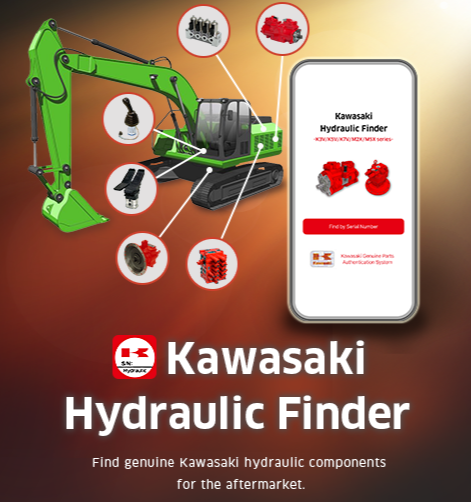
Kawasaki Heavy Industries’ “Kawasaki Hydraulic Finder” allows you to use the serial number on the nameplate to
identify genuine parts and confirm accurate information.
With the correct information in hand, you can contact an authorized dealer directly, so be sure to take advantage of
it.
Reviewed by

Ryoji Irie
Manager
After-Sales Promotion Office, Marketing & Sales Group, Precision Machinery & Robot Company, Kawasaki Heavy Industries, Ltd.
《Career History》
After joining Kawasaki Heavy Industries, I spent ten years developing the new K7V pump series as a design engineer, followed by five years at KPM (UK) as an application engineer supporting European OEMs and distributors. I am currently responsible for promoting the after-sales business globally.