Column
Hydraulic System Maintenance Checklist: Basic Practices to Extend Equipment Service Life
Daily maintenance is essential for keeping construction equipment operating reliably.
Because problems in the hydraulic system can lead directly to machine downtime, inspections at the proper intervals
are critical.
With the right knowledge of parts replacement and hydraulic fluid management, you can prevent unexpected failures and
ultimately reduce repair costs.
This article explains the components of a hydraulic system and the specific procedures used to maintain it.
It also covers the benefits of choosing genuine parts and how to make effective use of dedicated apps, so use it as a
reference when reviewing maintenance practices at your job site.
The Structure of a Hydraulic System and How Its Components Work Together
The system that powers construction equipment is made up of multiple components that operate in coordination with one
another.
Each part has a specific role, and power is transmitted through the interaction of all these components.
To help you understand the system as a whole, this section explains the following two points.
- The roles of the hydraulic pump, cylinders, motors, and control valves
- Why a fault in one area can affect the entire system
Once you understand how these components are connected, you can carry out day-to-day maintenance more efficiently.
Related Articles:Hydraulic System Troubleshooting: Common Problems, Causes, and Solutions
The Roles of the Hydraulic Pump, Cylinders, Motors, and Control Valves
The hydraulic pump is the device that pressurizes hydraulic fluid using power from the engine or another power
source.
The pressurized fluid then flows through the piping to the hydraulic cylinders and motors.
The cylinders convert hydraulic pressure into linear motion to move heavy components such as the arm.
The motors convert hydraulic pressure into rotary motion.
The control valves regulate the direction, pressure, and flow rate of the hydraulic fluid.
By working together, these components enable the complex and powerful movements required of construction
equipment.
Understanding the role of each one is the foundation of proper maintenance.
Related Articles:Hydraulic Pump Maintenance: Preventive Tips, Failure Signs, and Service Life
Why a Fault in One Area Can Affect the Entire System
Because hydraulic fluid is constantly circulating throughout the system, a problem in one component can easily spread
to others.
For example, if wear in the pump generates metal particles that mix with the fluid, those particles are carried
through the piping to other components.
If they clog a control valve, the entire machine may stop functioning properly.
If the packing in a cylinder deteriorates and causes an oil leak, system pressure drops and the machine can no longer
generate sufficient force.
Leaving even a minor abnormality unaddressed can lead to major repairs.
That is why it is so important to detect problems early through daily inspections.
Four Maintenance Approaches to Choose from Based on Equipment Condition
To keep equipment operating reliably, it is essential to choose the right maintenance approach for the situation.
Taking the appropriate action can reduce both the labor involved and the overall cost of repairs.
The following four approaches are commonly used.
- Planned maintenance (regular inspections and scheduled parts replacement)
- Preventive maintenance (early response through condition monitoring)
- Predictive maintenance (service life forecasting based on data)
- Avoiding reactive maintenance (the risks of waiting until after a failure occurs)
Adopt the approach that best suits your site and build an efficient maintenance system.
Planned Maintenance (Regular Inspections and Parts Replacement)
Planned maintenance involves inspecting and replacing parts at intervals based on the operating hours or elapsed time specified by the manufacturer.
Check hydraulic oil and filters on a planned schedule, and include hoses and seals in the maintenance program.
Knowing when maintenance is due makes it easier to coordinate the work with scheduled site downtime.
However, maintenance intervals alone do not tell you the condition of the machine.
Operating conditions, such as dust and high temperatures, affect how quickly components deteriorate.
Refer to the operator’s manual and maintenance records, and adjust inspection and replacement intervals to reflect the machine’s actual condition.
Preventive Maintenance (Early Intervention Through Condition Monitoring)
Preventive maintenance involves monitoring the machine’s condition and carrying out maintenance at the first signs of a problem.
Before starting work, check the hydraulic oil level and look for oil leaks.
During operation, check for unusual noises and vibration, and pay attention to changes in oil temperature and operating speeds.
After operation, inspect the hoses and fittings and check for leaks around the cylinders.
Record inspection results so they can be compared with the machine’s normal operating condition.
Assess the severity of any abnormalities to determine whether to stop the machine and consult a specialist.
Combined with planned maintenance, this approach can also help prevent unnecessary replacement of parts that are still serviceable.
Predictive Maintenance (Data-Based Service Life Prediction)
Predictive maintenance uses sensor readings and hydraulic oil analysis results to anticipate failures and component deterioration.
Record oil temperature, pressure, and vibration over time, and compare the readings with normal operating values to detect changes.
Hydraulic oil analysis checks viscosity and contamination levels, as well as the presence of water and wear particles.
If the accumulated data reveal deterioration trends, inspections and component replacements can be scheduled before problems become more serious.
However, measuring equipment and analysis come at a cost.
Compare the cost of implementation with the losses caused by breakdown-related downtime when deciding which machines to include.
Avoiding Reactive Maintenance (The Risks of Waiting Until a Breakdown)
Reactive maintenance involves repairing or replacing parts after a failure has occurred.
While this approach can reduce spending on inspections and preemptive replacements, the timing of a breakdown is unpredictable.
An unexpected shutdown can interrupt work, and the failure may also damage surrounding components.
Depending on parts availability, getting the machine back into service may take longer than expected.
Reactive maintenance should be avoided for critical machines whose failure could affect safety or project schedules.
However, it may be an option for auxiliary equipment when downtime has little impact and alternatives are available.
Base the decision on how critical the machine is and the consequences of failure.
Routine Maintenance and Hydraulic Oil Management Procedures to Prevent Failures
To help prevent hydraulic system failures, consistently monitor the condition of the hydraulic oil and carry out daily inspections.
The following five procedures are covered:
- Checking hydraulic oil condition, changing it appropriately, and managing its temperature
- Detecting oil leaks, unusual noises, and vibration early through daily inspections
- Replacing hydraulic filters and preventing contamination by foreign matter and water
- Regularly checking that air has been properly bled from the system and verifying pressure settings
- Extending hydraulic oil service life and preventing problems with an electrostatic oil cleaner (EDC)
In addition to maintaining the filters, have any necessary specialist adjustments carried out and use oil-cleaning equipment where appropriate.
Record inspection results to track changes in condition.
Hydraulic Oil Condition Checks, Proper Oil Changes, and Temperature Management
Use the oil level gauge to check that the hydraulic oil level is within the specified range.
Inspect the oil’s color and clarity, and check for unusual odors or a milky appearance.
Visible debris may indicate contamination by wear particles or other foreign matter.
When topping up or changing the oil, use hydraulic oil of the type and viscosity specified by the manufacturer.
Oil change intervals are not universal; follow the operator’s manual for the specific machine model.
Shorten inspection intervals when working in dusty environments or under sustained heavy loads.
If the oil temperature rises, check the oil level, filters, and oil cooler.
Do not touch hot components.
Check the temperature using the machine’s display or a measuring instrument.
Use Daily Inspections to Detect Oil Leaks, Unusual Noises, and Vibration Early
Detecting abnormalities quickly during daily pre-operation inspections is one of the basics of preventing serious
failures.
Visually inspect piping connections and the areas around cylinders carefully to make sure there is no oil seepage.
Oil leaks caused by worn packings can reduce pressure and lead to a loss of machine power.
If you notice sounds or vibrations during operation that are different from normal, the pump or motor may be under
excessive strain.
Do not overlook even small changes—record them, and consult a specialist immediately if anything concerns you.
Consistent daily checks can help prevent costly repairs.
Replacing Hydraulic Filters and Preventing Contamination by Foreign Matter and Water
Hydraulic filters protect hydraulic components by trapping contaminants in the oil.
The suction filter filters oil before it enters the pump, while the return filter filters oil as it flows back to the tank.
Clogged filters can reduce flow and cause pressure loss.
Distinguish between filters that can be cleaned and reused and those that require element replacement.
Follow the operator’s manual and any warning indicators to determine when replacement is needed.
Keep the oil filler opening and the equipment used for filling clean to prevent contaminants from entering the system.
If the hydraulic oil appears milky, check for possible water contamination.
Regularly Check for Trapped Air and Verify Pressure Settings
Air may remain in the hydraulic circuit after hoses or hydraulic components have been replaced.
Air-bleeding procedures vary by machine model and circuit. Repeatedly extending and retracting cylinders through their full stroke is not suitable for every machine.
High-pressure hydraulic oil poses hazards, including injection injuries if it penetrates the skin.
Measuring and adjusting pressure requires appropriate gauges and the manufacturer’s service documentation.
Setting the relief pressure too high can damage the pump and piping.
Have a specialist carry out any work for which the operator’s manual does not provide procedures.
Related Articles:Hydraulic Pump Not Building Pressure? Causes, Troubleshooting Steps, and Repair Costs
Extending Hydraulic Oil Service Life and Preventing Problems with an Electrostatic Oil Cleaner (EDC)
An electrostatic oil cleaner uses electrostatic forces to capture fine contaminants in hydraulic oil.
It is used to reduce fine sludge particles that are difficult to remove with conventional filters.
Compatible oil types and viscosities vary by product, and operating limits also apply to oil temperature and water content.
Effectiveness depends on the condition of the contaminated oil, and the cleaner may not remove all water or dissolved degradation products.
Use it as a supplementary method of maintaining oil cleanliness, not as a substitute for filter replacement or regular inspections.
Determine when to change the hydraulic oil based on oil analysis results and the manufacturer’s criteria.
Track Changes in Condition Through Inspection Records and Hydraulic Oil Analysis
Recording the results of daily inspections helps you track subtle changes in the hydraulic system.
Key details to record include:
- Inspection date and operating hours
- Hydraulic oil level and condition
- Oil temperature and pressure
- Location and severity of oil leaks
- Machine functions during which unusual noises or vibration occur
- Dates of filter replacements and hydraulic oil changes
- Type and quantity of hydraulic oil added
- Repair and component replacement history
Take hydraulic oil samples as needed to check contamination levels and water content.
Oil analysis also checks for changes in viscosity and the presence of wear metals.
Comparing the findings with previous results can help you detect internal component wear and hydraulic oil deterioration early and determine when inspections are needed.
The Risks of Non-Genuine Parts and How Genuine Parts Help Reduce Downtime
When carrying out repairs or replacing parts, choosing low-cost third-party, counterfeit, or imitation parts can
expose you to unexpected risks.
Non-genuine parts may be manufactured to different standards, which means they may not deliver the intended
performance and may cause early failures.
In some cases, the use of non-genuine parts may also void the manufacturer’s warranty.
Even if the initial purchase cost is lower, any need for rework can make the total cost significantly higher.
Using genuine parts supplied by the manufacturer reduces the risk of repeat repairs and helps minimize downtime.
From a long-term cost-performance perspective, choosing reliable genuine parts is a basic requirement for stable
operation.
Using an App to Identify the Correct Genuine Parts
When repairing machinery, many job sites struggle with the time and effort required to find the correct genuine
replacement parts.
That is where a dedicated app that streamlines parts identification can be especially useful.
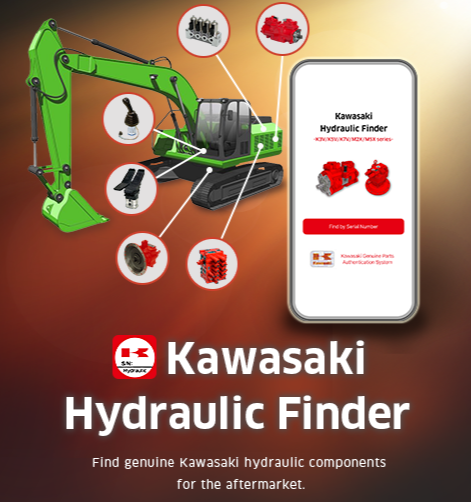
Kawasaki Heavy Industries’ “Kawasaki Hydraulic Finder” app makes it easy to search for the parts you need from a
smartphone.
By entering the serial number shown on the nameplate, you can identify genuine parts, confirm accurate part
information, and contact an authorized service center directly.
This reduces the burden of arranging parts and shortens the time needed to complete repairs.
If you are having trouble identifying replacement parts, consider using the app to make day-to-day maintenance
management more efficient.
Summary: Keep Construction Equipment Running Reliably Through Proper Hydraulic System Maintenance
Extending the service life of a hydraulic system requires ongoing management that combines regular hydraulic fluid
changes with daily inspections.
When repairs are needed, keeping the risks of non-genuine parts in mind and choosing genuine parts can help reduce
long-term operating costs.
Use Kawasaki Heavy Industries’ “Kawasaki Hydraulic Finder” to identify hydraulic components accurately.
From hydraulic fluid management to parts selection, consistent day-to-day maintenance is what leads to reliable
operation and a longer service life for your equipment.
Reviewed by

Ryoji Irie
Manager
After-Sales Promotion Office, Marketing & Sales Group, Precision Machinery & Robot Company, Kawasaki Heavy Industries, Ltd.
《Career History》
After joining Kawasaki Heavy Industries, I spent ten years developing the new K7V pump series as a design engineer, followed by five years at KPM (UK) as an application engineer supporting European OEMs and distributors. I am currently responsible for promoting the after-sales business globally.