Column
Excavator Repair Guide: Common Problems, Causes, and Solutions
Because hydraulic excavators operate in harsh jobsite conditions, unexpected problems can occur even with routine
maintenance.
Failures in the hydraulic system or around the cylinders, in particular, can quickly disrupt operations.
Related Articles:Hydraulic System Troubleshooting: Common Problems, Causes, and Solutions
This article explains the common causes of hydraulic excavator failures and the proper procedures for safe and
effective repairs.
It also covers the differences between genuine and non-genuine parts, along with typical repair costs, to help
minimize downtime on site.
Common Failure Points and Causes in Hydraulic Excavators
When a hydraulic excavator suddenly stops working on site, the problem is often concentrated in a few common
areas.
Identifying the cause early and taking the right corrective action can help prevent more serious damage.
The main types of failure can generally be grouped into the following four categories.
- Hydraulic system problems and deterioration of hydraulic fluid
- Cylinder damage and hydraulic fluid leaks
- Piping damage and age-related deterioration
- Operator error and excessive load on the machine
Review each of these conditions and determine which symptoms apply to your equipment.
Related Articles:Parts of an Excavator: Main Components, Structure, and Genuine Parts Guide
Hydraulic System Problems and Deterioration of Hydraulic Fluid
The hydraulic system, which controls the excavator’s movements, is particularly vulnerable when the quality of the
hydraulic fluid deteriorates.
Over time, hydraulic oil can become contaminated with moisture and fine debris, reducing its viscosity and preventing
it from delivering full performance.
When the fluid deteriorates, abnormal friction develops inside the hydraulic pump and valves.
This not only makes the machine sluggish, but also accelerates the wear of the seals that prevent leaks.
If regular oil inspections and scheduled oil changes are neglected, the pump itself may eventually fail.
Cylinder Damage and Hydraulic Fluid Leaks
The cylinders that move the boom and arm are constantly subjected to heavy loads, which makes them especially prone to
oil leaks.
The rubber packings and seals that keep the inside of the cylinder sealed gradually harden and crack because of heat
during operation, UV exposure, and deteriorated hydraulic fluid.
Once the seals fail, hydraulic fluid leaks out, pressure can no longer be maintained, and lifting force drops.
Damage to the cylinder rod caused by dirt or rocks striking it is also a common cause of seal failure.
Even minor seepage should not be ignored; replace the packings and seals as soon as possible.
Hydraulic Line Damage and Age-Related Deterioration
During daily inspections, check for surface wear, cracks, bulges, and deformation.
Also look for hardened rubber, oil leaks at fittings, and exposed reinforcement layers.
Surface cracks or scuffing alone do not necessarily indicate damage to the internal wire reinforcement.
However, bulges or significant deformation may indicate internal damage.
Exposed reinforcement or oil leaks are also signs that the hose should be taken out of service and replacement considered.
High-pressure oil can cause serious injury if it penetrates the skin, so never use your hands to locate a leak.
Shut down the machine and release any residual hydraulic pressure using the specified procedure.
Have a specialist carry out the inspection and any necessary replacement.
Operator Error and Excessive Load on the Machine
Forcing the machine beyond its designed capacity can seriously damage various parts of the excavator.
Lifting loads beyond the rated capacity or forcing the bucket through hard rock can subject the bucket and arm joints
to unexpected shock loads.
Continued operation under these conditions can crack welded sections of the frame and place excessive strain on the
crawler undercarriage, causing pins and bushings to wear prematurely.
Working on slopes in an unstable posture can also put extra strain on drive components such as the swing motor.
Repair Procedure When a Hydraulic Excavator Breaks Down
When a problem occurs, staying calm, checking the situation carefully, and following the proper steps is the best way to prevent further damage.
The following three steps are essential for carrying out repairs safely.
- Determine what can be handled by your own team
- Ask a specialist repair company to carry out disassembly and repair
- Perform a test run after the repair
Following these steps in order will help you restore the machine properly.
Stop Work and Ensure Safety if You Suspect a Fault
If unusual noises, oil leaks, or operating problems occur, stop work and prioritize safety.
If the machine can still be operated safely, bring it to a stop on firm, level ground, lower the work equipment to the ground, and then shut off the engine.
Keep the key secure and restrict access to the surrounding area as necessary.
If oil is leaking, never use your hands to locate the leak, as high-pressure oil can penetrate the skin.
Follow the site’s spill response procedures and use absorbent materials and spill containment equipment to prevent hydraulic oil from entering the soil or drainage channels.
When contacting a repair service, provide the following information:
- The time the problem occurred
- The operation being performed immediately beforehand
- Any warning lights or error messages displayed
- The type of unusual noise
- The location of any oil leaks
Also check the machine’s model and serial number. Photos taken from a safe location can help with diagnosis.
Determine Which Maintenance Tasks Can Be Handled In-House
Limit in-house maintenance to tasks covered by procedures in the operator’s manual and for which personnel have the necessary knowledge and equipment.
Typical examples include checking the hydraulic oil level, adding grease, and carrying out visual inspections.
Replace specified consumables only when the manufacturer’s procedures can be followed.
Have a specialist carry out the following tasks:
- Disassembling hydraulic circuits
- Measuring or adjusting hydraulic pressure
- Overhauling cylinders or pumps
- Diagnosing electrical system faults
- Removing and reinstalling tracks
Performing maintenance while the work equipment is supported by hydraulic pressure alone can cause the equipment to drop or the machine to tip over.
Work involving high-pressure oil also carries a risk of fluid injection injuries. If you are unsure whether a task can be performed safely, stop work.
Ask a Specialist Repair Company to Carry Out Disassembly and Repair
If the problem is beyond what your team can handle, contact a repair company that specializes in heavy equipment
without delay.
Jobs such as replacing a hydraulic pump, repairing internal engine components, or overhauling a cylinder require
diagnosis and workmanship from professional technicians.
When contacting the repair company, provide the manufacturer, model, hour meter reading, a clear description of the
symptoms, and when the problem occurred.
This helps the service team prepare the right replacement parts and tools before coming to the site.
Request an estimate in advance and review the breakdown of travel charges and basic labor costs before authorizing the
work.
Perform a Test Run After Repairs
After repairs, do not immediately resume normal work.
Make sure the surrounding area is safe and carry out a test run.
Begin by operating each function at low speed with no load, checking the following:
- Oil leaks from repaired areas
- Unusual noises or abnormal vibration
- Warning lights or error messages
- Operating speed and response to the controls
- The work equipment’s ability to hold its position
- Hydraulic oil temperature
If no problems occur under no-load conditions, gradually increase the load according to the manufacturer’s procedures.
Also test travel and swing, starting at low speed, and check whether any of the symptoms observed before the repair recur.
If oil leaks or unusual noises occur during the test run, stop operating the machine immediately.
Record your observations and contact the repair service. Do not resume normal work until the cause has been identified.
How to Choose Parts for Excavator Repairs
Choosing the right parts for a repair is a decision that affects both machine life and operating efficiency.
The following three points are key when selecting the right parts.
- The differences in performance and durability between genuine and non-genuine parts
- The risk that low-cost non-genuine parts can pose to surrounding components and the increase in downtime they can cause
- Accurate parts identification and locating an authorized service center using a dedicated app
Understand the characteristics of each option and choose parts based on both reliability and overall cost-effectiveness.
Differences in Performance and Durability Between Genuine and Non-Genuine Parts
Repair parts can be classified as follows based on their manufacturer and condition:
- Genuine parts: Parts produced to the manufacturer’s specifications and quality standards. Compatibility and warranty terms are easier to verify.
- Aftermarket replacement parts: Parts made by manufacturers other than the original equipment manufacturer. Materials, dimensions, durability, and warranty coverage vary by product.
- Used parts: Previously used components put back into service. Their operating hours, maintenance history, and degree of wear need to be checked.
- Reconditioned parts: Previously used components that have been disassembled and serviced. Check which parts have been replaced, what performance testing has been carried out, and the scope of warranty coverage.
When choosing parts, look beyond price and compare compatibility with the machine model, product quality, and information about the supplier.
How Low-Cost Non-Genuine Parts Can Put Other Components at Risk and Increase Downtime
Using non-genuine parts does not necessarily cause contamination or cavitation.
However, if a part’s dimensions or materials do not match the machine’s specifications, it may cause oil leaks or reduced operating speeds.
Incompatibility with the machine’s operating pressure or flow characteristics can also lead to abnormal wear and heat buildup.
When selecting parts, compare not only the purchase price but also the potential parts and labor costs of repeat repairs.
Consider labor costs incurred during downtime and the cost of temporary replacement equipment, and factor in the impact on the project schedule.
Accurate Parts Identification and Finding an Authorized Service Center Using a Dedicated App
A practical way to arrange genuine parts that match your machine is to use a dedicated app.
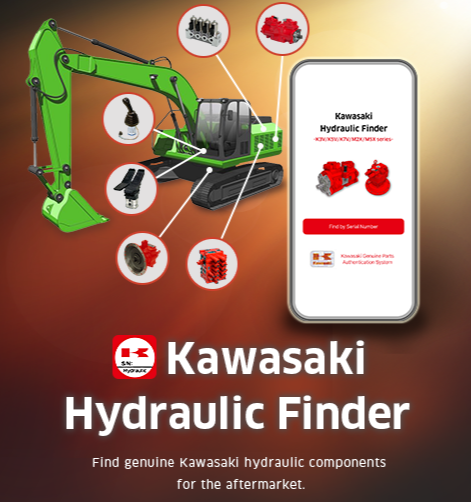
With Kawasaki Hydraulic Finder, you can simply enter the serial number of a pump or other component on your smartphone
and identify the correct part more accurately than by searching by model alone.
It also lets you locate the nearest manufacturer-authorized service center based on your location, making it easier to
move from parts identification to parts ordering and repair requests.
To avoid purchasing the wrong part and to hand the job over to technicians with the right expertise, it is well worth
considering.
Estimated Repair Costs for Hydraulic Excavators
When outsourcing repairs, having a general sense of the typical cost range can help you judge whether a quote is reasonable.
To help with that decision, consider the following three cost-related points.
- Typical labor and travel charges when hiring a repair contractor
- Replacement costs for parts such as cylinders and piping
- Criteria for deciding between repair and replacement based on operating hours, oil analysis, and trade-in value
Use these as a guide when comparing repair options against your budget.
Related Articles:Hydraulic Pump Repair Cost: Typical Prices for Excavators and Construction Machinery
Typical Labor Rates and Call-Out Charges for Professional Repairs
Repair costs depend not only on the base labor rate but also on the following factors:
- Time required and number of technicians needed
- Distance to the site
- Service vehicles and diagnostic equipment used
- Whether nighttime, holiday, or emergency call-outs are required
Rates vary by service provider, region, and working conditions.
Rather than relying on a single general price range, check the provider’s published rates and sample estimates that specify the machine model and scope of work.
When comparing estimates, review the following items:
- Base fees and hourly labor rates
- Call-out charges and diagnostic fees
- Parts and transport costs
- Conditions under which additional work may be required
Additional faults may be discovered after disassembly, so it is also worth confirming how the provider will notify you in advance of any extra charges and obtain your approval.
Replacement Costs for Parts Such as Cylinders and Piping
Repairs involving cylinders and piping, which are among the most common hydraulic excavator issues, vary in cost
depending on the scale of the replacement.
Replacing a single hydraulic hose typically costs anywhere from several tens of thousands of yen up to around JPY
80,000 (USD 500), depending on the machine and the type of hose.
By contrast, overhauling a leaking cylinder by disassembling it and replacing all internal packings and O-rings
typically costs around JPY 30,000 to 80,000 (USD 190 to 500).
If the hydraulic pump itself fails and must be replaced as a complete unit, the cost can jump to several hundred
thousand yen or even more than JPY 1,000,000 (USD 6280), which is why regular maintenance is so important.
Related Articles:Hydraulic Pump Replacement Guide: Cost, Timing, Procedures, and Maintenance Tips
Criteria for Deciding Between Repair and Replacement Based on Operating Hours, Oil Analysis, and Trade-In Value
If you receive a high repair estimate, it is time to carefully evaluate whether continued repair makes sense or
whether replacing the machine would be the better option.
In general, noticeable wear tends to appear once a hydraulic excavator exceeds around 4,000 to 5,000 operating hours,
and hydraulic components often approach the end of their service life as the machine nears 10,000 hours.
If oil analysis reveals a large amount of metal particles, that is a sign that overall deterioration is already well
underway.
Be especially cautious if the repair cost exceeds the machine’s trade-in value or if the repair would amount to more
than half the price of a new machine.
In such cases, replacement may be the wiser long-term choice.
Summary: Make the Right Repair Decision for Your Hydraulic Excavator Based on Cost and Intended Use
When a hydraulic excavator breaks down, it is important to consider not only the repair cost, but also how long the
machine is expected to remain in service.
Especially when replacing hydraulic components, choosing low-quality non-genuine parts can lead to reduced performance
and unexpected shutdowns.
With Kawasaki Hydraulic Finder, you can simply enter the serial number shown on the nameplate of a hydraulic pump or
other component to identify genuine parts and confirm accurate information.
Based on that information, you can also contact an authorized service center directly and move ahead with parts
ordering or repair arrangements more reliably.
Secure the right parts for your machine and keep your jobsite running smoothly.
Reviewed by

Ryoji Irie
Manager
After-Sales Promotion Office, Marketing & Sales Group, Precision Machinery & Robot Company, Kawasaki Heavy Industries, Ltd.
《Career History》
After joining Kawasaki Heavy Industries, I spent ten years developing the new K7V pump series as a design engineer, followed by five years at KPM (UK) as an application engineer supporting European OEMs and distributors. I am currently responsible for promoting the after-sales business globally.