Column
Hydraulic Pump Replacement Guide: Cost, Timing, Procedures, and Maintenance Tips
When a hydraulic pump on equipment in active use develops a problem, a quick response is essential, as delays can
affect the entire operation.
However, when it comes time to replace the part, many people are unsure about the likely cost or the actual steps
involved.
This article explains the key criteria for deciding when to replace a hydraulic pump and the typical cost range.
It also covers safe replacement procedures and how to choose parts that support long-term operation.
Use it as a reference for keeping your machinery running reliably.
When to Replace a Hydraulic Pump Instead of Repairing It
When a hydraulic pump starts to malfunction, it can be difficult to decide whether to repair it and keep using it or
replace it with a new unit.
Depending on the condition, replacing the entire pump may ultimately save both time and money.
Check the current condition of the pump and consider your next step based on the following three criteria.
- Severe damage that cannot be repaired through overhaul
- Cases where repair costs exceed the cost of replacement with a new unit
- Exceeding the manufacturer’s recommended operating hours or service life
If any of these conditions apply, it is best to arrange the necessary parts promptly and restore the machine as quickly as possible.
Related Articles:Hydraulic Pump Repair: Costs, Common Failure Causes, and Contractor Selection Guide
Severe Damage That Cannot Be Repaired Through Overhaul
If the internal components of the hydraulic pump are severely worn across a wide area, disassembly, cleaning, and
partial repair will not restore the pump to its original performance.
In particular, if seizure has occurred and metal fragments have spread throughout the inside of the pump, repair is
extremely difficult.
When this kind of catastrophic damage is present, even if time and effort are spent on disassembly and reassembly, the
pump is highly likely to fail again soon.
To avoid a situation where a temporary repair causes another interruption on site, full replacement is the appropriate
choice when the damage is extensive.
This gives you a much better chance of restoring the machine safely and reliably.
Related Articles:Hydraulic Pump Failure: Common Causes, Symptoms, and Troubleshooting Tips
Cases Where Repair Costs Exceed the Cost of Replacement with a New Unit
If the estimated cost of sourcing parts and carrying out the repair exceeds the cost of replacing the pump with a new
unit, replacement is usually the better option.
Disassembling an old pump, identifying the cause of the problem, ordering multiple small components individually, and
repairing the unit can require a great deal of labor.
This is especially true for older models, where dedicated repair parts may be difficult to obtain and may require both
high procurement costs and long lead times.
Compare the overall cost-effectiveness carefully. If the total repair cost exceeds half the price of a new replacement
unit or approaches the cost of replacement, it is generally better to install a new pump.
Exceeding the Manufacturer’s Recommended Operating Hours or Service Life
If the machine has exceeded the operating hours specified by the manufacturer, it may also be the right time to
replace the pump.
Once the manufacturer’s recommended operating hours have passed, invisible deterioration such as metal fatigue may be
accumulating even if there are no obvious symptoms.
To prevent major operational delays caused by sudden shutdowns, it is best to treat machines that have exceeded the
specified operating hours as being near the end of their service life.
Switching to a new part in a planned manner makes it easier to maintain both jobsite safety and stable machine
operation.
Typical Costs for Hydraulic Pump Replacement
Cost is one of the main concerns when replacing a hydraulic pump.
Because the size of the required part varies depending on the type and scale of the machine, total replacement costs
can vary widely.
To help with budget planning, let’s look at the typical costs for the following three types of machinery.
- Construction machinery and industrial machinery
- Agricultural machinery
- Forklifts
Understanding the general cost range in advance will make it easier to judge whether a quotation from a service provider is reasonable.
Related Articles:Hydraulic Pump Repair Cost: Typical Prices for Excavators and Construction Machinery
Construction Machinery and Industrial Machinery
For machinery used on large construction sites or in factories, costs tend to be relatively high because the parts
themselves are large and precisely engineered.
The total cost, including parts and labor, varies depending on the model.
For compact machines, replacement may cost several hundred thousand yen. For medium to large hydraulic excavators, the
cost is often JPY 500,000 (USD 3130) or more, and on some models it can exceed JPY 1,000,000 (USD 6260).
Depending on the work environment, travel charges or the cost of special tools may also be added.
When planning your budget, it is safer to allow some extra margin while taking into account the size of the machine
and the conditions at the work location.
Agricultural Machinery
Replacing the pump on agricultural machinery such as tractors or combine harvesters tends to cost somewhat less than
replacing one on construction machinery.
In many cases, the total cost, including parts and labor, falls in the range of approximately JPY 50,000 to 150,000
(USD 310 to 940).
For a small tractor in particular, relatively inexpensive parts may be sufficient, and the repair may cost around JPY
50,000 (USD 310).
Another characteristic is that service shops affiliated with agricultural cooperatives often provide clear labor
charges and reasonable pricing.
Because a breakdown during the busy season can seriously delay agricultural work, it is important to secure a budget
and respond early.
Forklifts
The cost of replacing a hydraulic pump on a forklift used daily at logistics facilities and similar operations varies
depending on the machine’s load capacity and parts availability.
As a general guideline, you should expect a cost of around JPY 100,000 to 250,000 (USD 625 to 1560).
Small forklifts with a load capacity of less than one ton may be relatively inexpensive, but for larger machines
exceeding three tons, parts costs can rise significantly.
Forklifts repeatedly lift and lower heavy loads every day, placing substantial stress on the hydraulic pump.
Rather than compromising with low-cost parts, it is better to plan your budget with long-term operation in mind,
taking into account how frequently the machine is used and how heavy the workload is.
Why Genuine Parts Matter When Arranging a Replacement Pump
It can be tempting to choose inexpensive non-genuine parts, but to maintain machine performance, it is safer to choose genuine parts backed by the manufacturer.
When arranging parts, keep the following three points in mind.
- The risks of replacing the entire assembly with a non-genuine unit
- The safety and long-term operation benefits of replacing with genuine parts
- Identifying the correct compatible pump using an app
Choosing the right parts helps prevent future trouble and unnecessary expense.
The Risks of Replacing the Entire Assembly with a Non-Genuine Unit
Replacing the complete unit with a non-genuine assembly may reduce the initial cost, but it increases the risk of
early failure and may void warranty coverage.
Parts that do not meet the original design tolerances or material quality standards can also accelerate wear in
surrounding components such as valves and cylinders.
As a result, unexpected downtime may occur repeatedly, interfering with jobsite operations.
In many cases, the final lifecycle cost becomes higher than it would have been if genuine parts had been used from the
beginning.
The Safety and Long-Term Operation Benefits of Replacing with Genuine Parts
Genuine parts supplied by the manufacturer are produced based on the machine’s design drawings and must pass strict
quality tests.
As a result, they can deliver the intended performance after installation and help prevent damage to surrounding
systems caused by contamination or poor-quality replacement parts.
Because material strength and durability are maintained to a high standard, genuine parts can be used safely over the
long term even in harsh jobsite environments.
They help reduce downtime caused by failure and can ultimately lower the total lifecycle cost of operating the
machine.
Identifying the Correct Compatible Pump Using an App
Today, many replacement parts are difficult to distinguish from genuine parts by appearance alone.
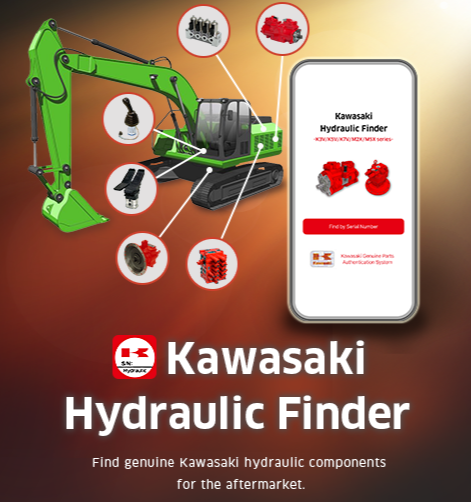
This is where Kawasaki Heavy Industries’ dedicated app, “Kawasaki Hydraulic Finder,” can be useful.
By simply entering the serial number stamped on the part’s nameplate, you can instantly identify whether it is a
genuine part and confirm accurate information.
By using this kind of digital tool, you can accurately identify the parts compatible with your equipment and make
faster decisions about parts procurement, repair, or replacement.
Specific Hydraulic Pump Replacement Procedure
Once the new part has arrived, the actual replacement work can begin.
Because the work involves heavy components and high-pressure hydraulic fluid, it is essential to follow the correct
sequence and proceed carefully.
When working on site, follow these four steps.
- Prepare for the work and confirm safety before starting
- Remove the old pump
- Install the new pump
- Refill the hydraulic fluid and check operation
Understanding the workflow in advance will help the work proceed more smoothly.
Prepare for the Work and Confirm Safety Before Starting
Before starting the actual work, secure the surrounding area and depressurize the machine.
First, park the machine on a flat, stable surface, stop the engine to prevent unintended movement, and disconnect the
battery terminals.
Next, slowly release any pressure remaining in the piping or tank to prevent accidents such as burns caused by hot oil
spraying out.
Do not forget to prepare a dedicated drain pan to catch spilled oil and plenty of rags for wiping up hydraulic
fluid.
By making thorough preparations before picking up your tools, you can carry out the remaining work safely and
smoothly.
Remove the Old Pump
Once safety has been confirmed, carefully remove the old pump currently installed on the machine.
Start by draining the hydraulic fluid from the tank, then disconnect the hoses and pipes connected to the pump one by
one.
At this stage, if dirt enters the connection points, it can cause new failures, so attach protective caps to the
disconnected ends.
After all piping has been removed, loosen the bolts securing the pump body and slowly pull the unit out.
Oil remaining inside may spill, so it is a good idea to protect the surrounding area beforehand.
Because the pump is heavy, avoid injury by supporting it with multiple people and removing it in a stable posture.
Install the New Pump
Carefully place the newly arranged part in the position where the old pump was removed.
Installation is performed in the reverse order of removal, but as a general rule, all packings and O-rings at the
connections to pipes and hoses should be replaced with new ones.
Clean the connection areas thoroughly with parts cleaner or a similar product to prevent dirt from entering, then
insert the pump shaft and align the pump in its proper position.
To prevent oil leaks caused by the pump being installed at an angle, temporarily tighten all mounting bolts first and
then fully tighten them.
Finally, connect the hoses and piping, and carefully check that there is no twisting or looseness before proceeding.
Refill the Hydraulic Fluid and Check Operation
After all parts have been installed, refill the tank with new hydraulic fluid up to the specified level.
Immediately after refilling, air will remain inside the piping, so start the engine and, with it idling, operate the
hydraulic levers to bleed air from the system and check operation.
Air remaining in the system can cause unusual noise and poor movement, so bleed it carefully.
At the same time, use a pressure gauge to confirm that the values are within the normal range specified in the
operating manual for the machine, and make fine adjustments if necessary.
Finally, inspect each connection for oil leaks and complete the process with a final test run.
Related Articles:How to Test a Hydraulic Pump: Step-by-Step Methods and Inspection Procedures
Summary: Maintain Stable Operation Through Proper Hydraulic Pump Replacement
When replacing a hydraulic pump, making the right decision between repair and replacement and selecting the correct
parts are essential for maintaining stable operation.
Costs vary depending on the type of machine and how it is used, so use the cost ranges introduced above as a guide
when planning your budget.
Using genuine parts helps prevent unnecessary secondary failures and allows the machine to deliver its maximum service
life.
By using Kawasaki Heavy Industries’ “Kawasaki Hydraulic Finder,” you can quickly confirm the model of the hydraulic
pump installed on your machine and consult an authorized service provider more smoothly.
Use it to help keep your machinery operating reliably.
Reviewed by

Ryoji Irie
Manager
After-Sales Promotion Office, Marketing & Sales Group, Precision Machinery & Robot Company, Kawasaki Heavy Industries, Ltd.
《Career History》
After joining Kawasaki Heavy Industries, I spent ten years developing the new K7V pump series as a design engineer, followed by five years at KPM (UK) as an application engineer supporting European OEMs and distributors. I am currently responsible for promoting the after-sales business globally.