Column
How Hydraulic Systems Work Guide: Principles, Components, Troubleshooting, and Maintenance
Have you ever had heavy equipment on site suddenly start moving poorly, leaving you unsure of the cause?
Many types of construction machinery operate by using the power of fluid, and understanding this structure makes it easier to respond when trouble occurs.
This article explains how hydraulic systems work using Pascal’s principle, why oil is used instead of water, daily inspection points, and what to do when abnormalities occur.
Read on to learn how to arrange reliable genuine parts and help extend the service life of your machinery.
What Is a Hydraulic System? An Overview of the Technology That Moves Heavy Equipment Using Fluid Power
Behind the powerful movement of large heavy equipment is a mechanism in which fluid transmits force through sealed pipes.
Understanding this basic structure will give you a deeper understanding of the machine’s performance.
Let’s look at hydraulic systems from three perspectives: the basic principle, comparison with other power transmission methods, and why hydraulics are used in construction machinery.
- Pascal’s principle and how force is amplified
- Main characteristics of hydraulic systems compared with other power transmission methods
- Why hydraulic systems are used in construction machinery
Understanding these characteristics will help you operate machinery properly on site.
Pascal’s Principle and How Force Is Amplified
Pascal’s principle refers to the phenomenon in which pressure applied to one part of a fluid inside a closed container is transmitted equally throughout the entire fluid.
By using this principle, it is possible to generate a large force from a small input force.
For example, when fluid pushed through a narrow pipe moves into a wider pipe, the pushing force is amplified according to the difference in surface area.
This is why an operator can move a lever with only a small force and still easily control the arm of a heavy machine capable of lifting several tons of soil.
The advantage is that a limited power source can be used to its fullest. Once you understand the structure, it also becomes easier to infer the cause when something goes wrong.
Main Characteristics of Hydraulic Systems Compared with Other Power Transmission Methods
There are several ways to transmit power in machinery, including electricity and compressed air, as well as fluid.
Electric motors are excellent for precise control, but when very large force is required, the equipment itself tends to become larger.
Compressed-air systems respond quickly, but the force they can generate is inherently limited.
By contrast, systems that use fluid can produce strong force while keeping the overall equipment relatively compact.
They also make it easier to incorporate safety devices that protect the system when excessive load is applied.
For harsh job sites that require heavy-duty work, hydraulics are an excellent choice.
Why Hydraulic Systems Are Used in Construction Machinery
Construction sites often require continuous high force, such as when breaking hard rock or moving large volumes of soil.
Hydraulic systems make it possible to transmit power freely through piping, even to places far from the power source or to parts with complex joints, such as an excavator arm.
Hydraulic systems are also resistant to external impact and weather changes, and they operate reliably even in harsh outdoor environments with mud, dust, and sand.
They are an essential technology for meeting the demanding working conditions found on construction sites.
Why Use Oil Instead of Water or Air?
It may seem reasonable to use water, a familiar and readily available liquid, to fill the pipes.
However, actual construction machinery uses specially formulated hydraulic fluid. Here, we explain why oil is necessary from two perspectives.
- The three key properties of hydraulic fluid
- Why water or air cannot be used as substitutes
Understanding the unique properties of oil makes it clear why a dedicated fluid is used.
The Three Key Properties of Hydraulic Fluid
The oil used inside machinery has three major properties: power transmission, lubrication, and rust prevention.
Because its volume changes very little even when compressed, it can transmit pressure with minimal loss.
It also acts as a lubricant that reduces friction between metal parts and forms an oil film on surfaces to prevent rust.
Thanks to these properties, internal components are less likely to wear out, even when heavy equipment performs demanding work repeatedly over long periods.
Why Water or Air Cannot Be Used as Substitutes
If the pipes were filled with water, metal components would quickly rust and wear severely due to friction.
Water also freezes at 0°C and boils at 100°C, making it unsuitable for job sites where temperature changes significantly depending on the season and operating conditions.
Air, on the other hand, compresses greatly when pressure is applied.
Even if force is applied, the air simply compresses like a cushion, making it unsuitable for transmitting the force needed to lift heavy objects.
To transmit power directly while preventing rust and friction and withstanding a wide range of temperature changes, dedicated hydraulic oil is the best option.
Main Components of a Hydraulic System and Their Roles
To move one large machine, multiple components inside the system work together to generate and transmit power.
Let’s look at the role of each component in three categories, following the flow of power transmission.
- Types and characteristics of hydraulic pumps that deliver hydraulic fluid
- Hydraulic cylinders and motors that convert hydraulic energy into movement
- The role of control valves and tanks in regulating hydraulic fluid flow
Understanding the role of each component will make it clearer which areas need to be inspected.
Types and Characteristics of Hydraulic Pumps That Deliver Hydraulic Fluid
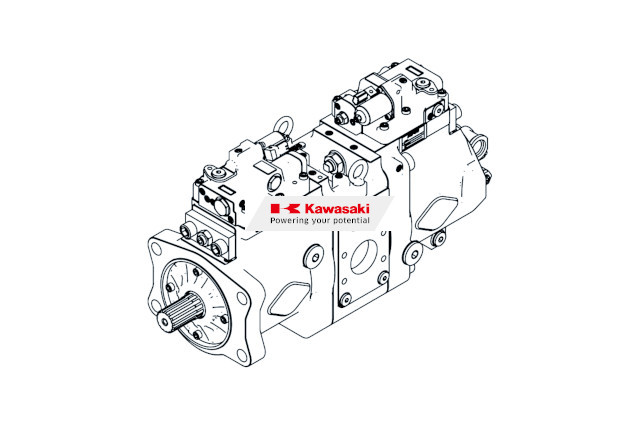
The role of the pump is to use engine rotation to draw in hydraulic fluid and forcefully push it into the piping.
Common types include gear pumps, which move fluid using meshing gears, and piston pumps, which move pistons back and forth inside cylinders.
Gear pumps have a simple structure, are less prone to failure, and are relatively inexpensive.
Piston pumps, by contrast, can generate higher pressure and finely adjust the amount of fluid delivered.
Different pump types are used depending on the application, and together they serve as the heart of the entire hydraulic system.
Related Articles:Hydraulic Pump Types Guide: Gear, Vane, and Piston Pumps for Construction Machinery
Hydraulic Cylinders and Motors That Convert Hydraulic Energy into Movement
These are the actuating components that receive the force of the fluid sent from the pump and convert it into actual machine movement.
A cylinder uses hydraulic force to push a rod out of a tube, creating the linear motion that bends and extends an excavator arm.
A motor, on the other hand, uses the force of flowing fluid to rotate a shaft, producing continuous rotational force for crane swing movement, wheel drive, and other functions.
Both components act like powerful arms and legs, converting fluid energy into the linear and rotary motion required on site.
The Role of Control Valves and Tanks in Regulating Hydraulic Fluid Flow
Control valves regulate the flow of hydraulic fluid so that the pump and the actuating components are properly connected.
They switch the direction in which the fluid flows, adjust the flow rate to change the speed of heavy equipment, and release oil during abnormal high-pressure conditions to prevent pipe rupture.
The tank temporarily stores the hydraulic fluid after it has circulated through the piping.
It also helps air bubbles rise and escape, and allows heated oil to cool.
Together, these components enable heavy equipment to operate safely and smoothly.
Common Hydraulic Problems in Construction Machinery
When work continues on site, machinery may suddenly start moving poorly.
If you understand the causes behind each symptom, you can respond calmly.
Here are three typical problems that commonly occur on site and their main causes.
- Main causes of insufficient power and sluggish operation
- Main causes of unusual noise, vibration, and overheating
- Common locations and main causes of oil leaks
Recognize warning signs early and take action before they develop into serious failures.
Related Articles:Hydraulic System Troubleshooting: Common Problems, Causes, and Solutions
Main Causes of Insufficient Power and Sluggish Operation
If the arm does not move powerfully when the lever is pulled, or if operation feels clearly slower than usual, the hydraulic fluid level may be low.
In many cases, dirt or debris has mixed into the fluid after long-term use and is blocking narrow passages inside valves.
Another possible cause is wear inside the piping or components, allowing pressure to escape from areas that should normally remain sealed.
First, check whether the tank contains the specified amount of hydraulic fluid.
If the fluid has not been replaced for a long time, replacing it with new fluid may improve the symptoms.
Main Causes of Unusual Noise, Vibration, and Overheating
If you hear metallic noises that are not normally present, or feel unnatural vibration, air may have entered the piping.
When air bubbles collapse inside the pump, they create impacts that strike internal components, causing loud noise and vibration. It is also common for the hydraulic fluid to overheat at the same time.
If the temperature rises too high, the hydraulic fluid deteriorates and can cause catastrophic damage such as component seizure.
If you notice unusual noise or excessive heat, stop the machine immediately and bleed the air from the system as soon as possible.
Common Locations and Main Causes of Oil Leaks
If hydraulic fluid is seeping from pipe connections or cylinder gaps, the main cause is often deterioration of rubber components such as packings and seals.
These parts gradually harden due to heat and friction and lose their ability to seal.
Cracks in metal piping caused by strong impact, or loosened nuts, can also lead to leaks.
Even slight seepage can expand over time if left unaddressed, eventually preventing the system from transmitting power at all.
Inspect the surrounding area visually on a regular basis, and if you find a wet area, replace the affected part promptly.
Daily Inspections and Regular Replacement Procedures to Extend Hydraulic System Life
Extending machine life requires careful day-to-day attention.
Here are three maintenance practices that can be easily incorporated into on-site work.
- Check the hydraulic fluid level and condition before starting work
- Replace filters and hydraulic fluid at the specified intervals
- Properly bleed air from the hydraulic system
Make these inspections part of your daily routine to help prevent delays caused by unexpected trouble.
Related Articles:Hydraulic System Maintenance Checklist: Basic Practices to Extend Equipment Service Life
Check the Hydraulic Fluid Level and Condition Before Starting Work
Before starting work each day, check the sight glass or gauge on the side of the tank to confirm that the hydraulic fluid level is within the specified range.
If the level is too low, the pump may draw in air and fail. If it is too high, the fluid may expand with heat and leak out.
At the same time, check the color and smell of the fluid.
If the fluid looks milky, water may have entered the system. If it smells burnt, heat-related deterioration may be progressing.
Operating the machine while these abnormalities are present can damage components, so do not skip this brief but important visual inspection before work begins.
Replace Filters and Hydraulic Fluid at the Specified Intervals
Filters remove dirt and fine metal particles, but they become clogged after long-term use.
Hydraulic fluid itself also loses lubricating performance when used for long periods in high-temperature, harsh conditions.
The machine’s operating manual specifies replacement intervals based on operating hours, and these standards should be followed strictly.
Even if the fluid looks clean, its internal properties may have deteriorated, so it is a good idea to keep records of operating hours.
Keeping clean hydraulic fluid circulating through the system helps maintain heavy equipment performance over the long term.
Properly Bleed Air from the Hydraulic System
After replacing a pump or changing the hydraulic fluid, air may remain inside the piping.
If the machine is operated in this condition, unusual noise and vibration can occur. Run the engine at low speed and slowly extend and retract the cylinders to push the air out.
If necessary, slightly loosen the dedicated air bleed valve and allow fluid containing bubbles to seep out.
Once only clear hydraulic fluid flows out, the procedure is complete.
Removing air properly eliminates shock to internal components and restores smooth machine movement.
Repair and Parts Replacement Options and How to Decide
Even with daily inspections, parts eventually reach the end of their service life after many years of use and need to be replaced.
If an oil leak cannot be fixed simply by replacing the packing, or if severe abnormal noise from the pump itself does not go away, it may be necessary to replace the entire component with a new one.
At that point, avoid choosing low-cost third-party, counterfeit, or imitation parts simply because they look similar and seem less expensive.
Even a slight dimensional mismatch can cause another leak or trigger a chain reaction that damages other components that were previously functioning properly.
From a long-term operating perspective, choosing quality-assured genuine parts often results in lower overall repair costs.
Related Articles:Hydraulic Pump Rebuild Guide: Process, Costs, Failure Causes, and Provider Selection
How to Verify Genuine Hydraulic Parts and Request Service from an Authorized Provider
For repairs, the most reliable approach is to identify the exact model number of the part currently in use and request service through a manufacturer-authorized channel.
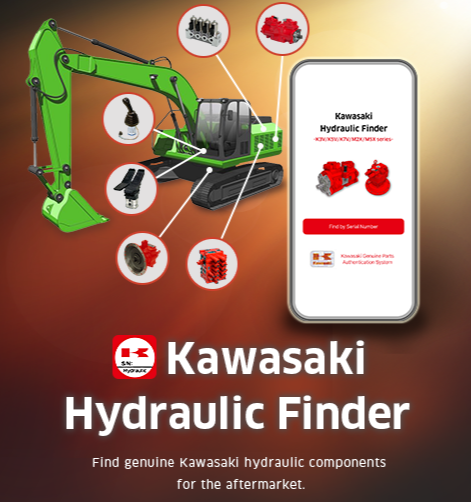
With Kawasaki Heavy Industries’ dedicated “Kawasaki Hydraulic Finder” app, you can simply enter the number stamped on the part to confirm whether it is genuine.
If the part is confirmed to be genuine, accurate information such as the model code and part number is displayed immediately, making it easier to arrange repairs through an authorized dealer.
Identify genuine parts quickly on site and entrust parts replacement or repair to qualified specialists with confidence.
Summary: Consistent Daily Management Determines Machine Life and Cost
When hydraulic problems occur in construction machinery, accurately identifying the correct replacement parts and taking the right action are essential for fast and reliable repair.
By using “Kawasaki Hydraulic Finder,” you can quickly confirm whether a part is genuine from the serial number on the nameplate and avoid mistakes in parts identification.
To reduce downtime and proceed with maintenance confidently, make use of the app and consult an authorized dealer.
Reviewed by

Ryoji Irie
Manager
After-Sales Promotion Office, Marketing & Sales Group, Precision Machinery & Robot Company, Kawasaki Heavy Industries, Ltd.
《Career History》
After joining Kawasaki Heavy Industries, I spent ten years developing the new K7V pump series as a design engineer, followed by five years at KPM (UK) as an application engineer supporting European OEMs and distributors. I am currently responsible for promoting the after-sales business globally.