Column
Hydraulic Pump Types Guide: Gear, Vane, and Piston Pumps for Construction Machinery
It is not uncommon to encounter hydraulic system problems in construction machinery, such as slower operation or unusual noise.
When considering repairs or parts replacement, it is important to understand the structure and characteristics of the pump installed on your machine.
This article explains the role of hydraulic pumps, three common pump types, and the advantages and disadvantages of each.
It also covers what to do when a pump fails, daily maintenance procedures, and information about a useful app, so use it as a reference for keeping construction machinery operating reliably.
What Is a Hydraulic Pump?
To understand the hydraulic equipment that serves as the heart of construction machinery, it is essential to first understand the component that generates power.
Before looking at each pump type in detail, let’s review the basic role of a hydraulic pump and how it is classified.
This section covers the following two points.
- The role and operating principle of a hydraulic pump
- The difference between fixed displacement and variable displacement pumps
Understanding these basics will make it easier to follow the explanations of each pump type later in the article.
The Role and Operating Principle of a Hydraulic Pump
A hydraulic pump is a device that converts mechanical rotational energy from an engine or electric motor into fluid pressure energy.
It draws hydraulic fluid from the tank and supplies the required pressure and flow through piping to actuators such as hydraulic cylinders and motors.
Hydraulic systems apply Pascal’s principle, allowing a relatively small input force to be amplified into a powerful force. This makes hydraulic pumps essential for construction machinery that lifts heavy soil or drives the machine itself.
In most hydraulic systems, the pump is the core power source, and its performance directly affects the overall working efficiency and power of the machine.
Related Articles:Hydraulic Pump Components Guide: Main Parts, Functions, and Failure Response
The Difference Between Fixed Displacement and Variable Displacement Pumps
Hydraulic pumps are broadly divided into fixed displacement and variable displacement types depending on whether the discharge volume can be adjusted.
A fixed displacement pump delivers the same amount of hydraulic fluid every time the drive shaft completes one revolution.
Because the structure is simple and cost-effective, this type is suitable for sections that repeatedly perform the same operation.
A variable displacement pump, on the other hand, can continuously change the discharge volume per revolution by moving an internal mechanism, allowing pressure and flow to be adjusted flexibly according to operating conditions.
For this reason, variable displacement pumps are widely used as the main hydraulic power source in construction machinery that requires complex movement and precise control.
Overview of the Three Main Types of Hydraulic Pumps and Their Characteristics
The hydraulic pumps mainly used in construction machinery can be divided into the following three types based on their internal structure.
To help you identify the type installed on your machine during troubleshooting or maintenance, the table below summarizes each type.
| Pump type | Structure and operating principle | Main characteristics | Pressure range and applications |
|---|---|---|---|
| Gear pump | Meshing gears send hydraulic fluid through the pump | Simple structure and low cost | Suitable for low to medium pressure and auxiliary functions |
| Vane pump | A rotor and multiple vanes move the hydraulic fluid | Low pulsation and quiet operation | Suitable for medium to high pressure and smooth operation |
| Piston pump | Reciprocating pistons push out hydraulic fluid | Capable of supplying high pressure and high flow | Suitable for high pressure and main power systems in construction machinery |
As shown above, each pump type differs clearly in its suitable pressure range, cost, and durability.
To maintain stable machine operation, it is essential to understand the characteristics of the pump installed on your equipment.
Characteristics of Gear Pumps and Their Role in Construction Machinery
Gear pumps are widely used in industrial machinery and are typically used for auxiliary functions in construction machinery.
This section explains the following two points.
- The structural differences between external and internal gear pumps
- The advantages, disadvantages, and main applications of gear pumps
Understanding these points will help with daily maintenance and replacement decisions.
The Structural Differences Between External and Internal Gear Pumps
Gear pumps are divided into two types based on their internal structure: external gear pumps and internal gear pumps.
In an external gear pump, two gears of the same size rotate while meshing externally, trapping hydraulic fluid in the spaces between the gears and the casing and carrying it to the discharge port.
This design is simple and easy to handle.
An internal gear pump, on the other hand, combines a large internal gear with a smaller external gear that rotates eccentrically inside it.
Because the two gears rotate in the same direction while moving the fluid, there is less fluid trapping and fewer sudden pressure changes. Compared with external gear pumps, internal gear pumps tend to operate more quietly and with less vibration.
The Advantages, Disadvantages, and Main Applications of Gear Pumps
The main advantages of gear pumps are their simple structure, low number of parts, resistance to failure, and low manufacturing cost.
They also have strong suction capability and are relatively tolerant of contamination in the fluid.
Their disadvantages are that they are fixed displacement pumps and cannot adjust discharge volume, and external gear types in particular can be noisy during operation.
They are also not well suited to high-pressure applications.
In construction machinery, gear pumps are commonly used in subsystems that support the main hydraulic circuit, such as lubrication oil circulation systems and steering assist mechanisms where extremely high pressure is not required.
Characteristics and Main Applications of Vane Pumps
Vane pumps are valued in certain applications because of their characteristically smooth operation.
They move fluid using a different mechanism from gear pumps and piston pumps, and understanding how they work leads to better operation and maintenance.
This section explains the following two points.
- The structure and operating principle of vane pumps
- The advantages, disadvantages, and main applications of vane pumps
By comparing these characteristics, you can see the kinds of situations where vane pumps are most effective.
The Structure and Operating Principle of Vane Pumps
A vane pump has a rotor with multiple slots that rotates inside an outer housing called a cam ring.
Thin plates called vanes are inserted into the rotor slots. When the rotor begins to rotate, centrifugal force or spring force pushes the vanes outward so that they remain in contact with the inner wall of the cam ring.
As the eccentric rotor turns, the volume between adjacent vanes and the cam ring expands and contracts. Hydraulic fluid is drawn in as the volume expands and discharged as the volume contracts.
The Advantages, Disadvantages, and Main Applications of Vane Pumps
The advantage of a vane pump is that it continuously moves fluid with multiple vanes, resulting in low pulsation and quiet operation.
Even when the vane tips wear, centrifugal force or spring force keeps pushing them outward, allowing the pump to maintain stable performance over a long period.
The disadvantage is that the vanes are relatively prone to damage, so regular inspection is necessary.
Because of their low-noise characteristics, vane pumps are often used in machine tools operated indoors and in steering systems that require especially smooth movement among construction machinery applications.
Characteristics of Piston Pumps and Their Role in Construction Machinery
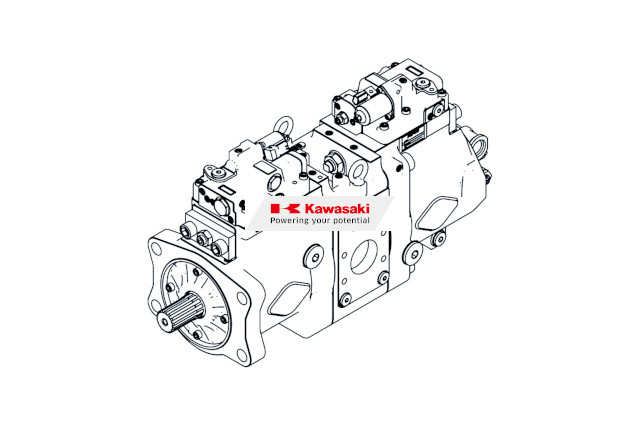
In modern construction machinery, including hydraulic excavators, piston pumps have effectively become the standard for generating main hydraulic power.
They incorporate various design features to deliver the high force required on site.
This section explains their characteristics from the following three perspectives.
- The structural differences between swash plate and bent-axis designs
- How variable displacement control works
- The advantages, disadvantages, and applications of piston pumps in construction machinery
Understanding the structure and control method will make it clear why piston pumps support such high working efficiency.
Related Articles:Hydraulic Piston Pump Guide: Structure, Types, Operating Principles, and Failure Signs
The Structural Differences Between Swash Plate and Bent-Axis Designs
Most piston pumps are axial piston pumps, in which multiple pistons are arranged in a circle inside a cylinder block. They are mainly divided into swash plate and bent-axis types.
In a swash plate pump, the cylinder block is arranged parallel to the drive shaft and rotates while the pistons press against an angled plate called a swash plate, causing them to reciprocate.
In a bent-axis pump, the cylinder block itself is positioned at an angle to the drive shaft. As it rotates, the pistons are pulled out and pushed in to discharge hydraulic fluid.
How Variable Displacement Control Works
One reason piston pumps are widely used in construction machinery is that they can easily achieve variable displacement control.
In swash plate pumps in particular, the piston stroke can be freely changed simply by adjusting the tilt angle of the swash plate against which the pistons press.
Increasing the swash plate angle increases the discharge volume per revolution, while reducing the angle toward zero decreases the discharge volume.
By automatically adjusting this angle through hydraulic or electronic control according to machine load and operator lever input, the system can use engine power efficiently and support precise, efficient work.
Related Articles:Variable Displacement Pump Guide: Structure, Working Principles, Pressure Adjustment, and Maintenance
The Advantages, Disadvantages, and Applications of Piston Pumps in Construction Machinery
The advantages of piston pumps are their ability to withstand high pressure and supply a large flow of hydraulic fluid in a stable manner.
The variable displacement control described above also gives them high energy efficiency.
Their disadvantages are that they are expensive to manufacture because they contain many precision components, and they are sensitive to contamination in the hydraulic fluid.
Dirty fluid can cause serious internal damage, so keeping the hydraulic fluid clean is essential.
Even so, because of their high performance, piston pumps are used as core components in construction machinery, such as main pumps that move the arm and boom of hydraulic excavators and systems that drive travel motors.
What to Do When a Hydraulic Pump Fails
Hydraulic system trouble is an unavoidable part of operating construction machinery.
To reduce downtime, quick and accurate judgment is essential when you notice an abnormality.
As practical response procedures, this section explains the following two points.
- Identify the cause from the symptoms
- Evaluate the cost-effectiveness of repair versus parts replacement or pump replacement
Use these points as a reference for recognizing warning signs and choosing the best solution for the situation.
Identify the Cause from the Symptoms
Hydraulic pump problems often appear clearly in machine movement or sound.
For example, if discharge performance is poor and the machine cannot deliver enough power or speed, internal components may be worn, allowing hydraulic fluid to leak internally and preventing proper pressure from being maintained.
If you hear unusual noise around the pump, abnormalities such as cavitation or aeration may be occurring.
First, visually check whether the piping is cracked or hydraulic fluid is leaking. Then use differences in sound and machine behavior to determine whether the problem is likely to be with the pump body itself.
Evaluate the Cost-Effectiveness of Repair Versus Parts Replacement or Pump Replacement
Once the cause has been identified, decide whether to repair the pump or replace it with a new one.
If the symptoms are caused by a faulty valve or air mixed into the fluid, costs can often be kept down through replacement of the affected parts or overhaul.
However, if seizure or severe wear has occurred in metal components such as pistons or cylinders, repair costs tend to become high.
If the machine has already been used for many years, there is also a risk that another section may fail soon even after the pump is repaired.
For this reason, replacing the pump with a new genuine assembly may be more cost-effective and can be the better choice from a long-term lifecycle cost perspective.
Maintenance Methods to Extend Hydraulic Pump Life
Daily management and regular care are essential for avoiding expensive repairs and sudden machine stoppages.
The service life of a hydraulic pump depends greatly on the quality of maintenance.
From a preventive maintenance perspective, this section explains the following two specific practices.
- Follow the replacement cycle for hydraulic fluid and filters
- Perform daily inspections and manage hydraulic fluid contamination
By carrying out these basic tasks on site, you can maintain the pump’s original performance for longer and support stable operation.
Related Articles:Hydraulic Pump Maintenance: Preventive Tips, Failure Signs, and Service Life
Follow the Replacement Cycle for Hydraulic Fluid and Filters
Most hydraulic pump trouble is triggered by degraded or contaminated hydraulic fluid.
For that reason, it is effective to check the fluid level regularly, clean the filters, and strictly follow the replacement cycle recommended by the manufacturer.
As a general guideline, hydraulic fluid is often replaced about once a year, but for construction machinery, it should basically be managed based on operating hours shown on the hour meter.
If harsh attachments such as breakers are used, replacement may be required sooner.
Oil also deteriorates more quickly in dusty environments such as quarry sites, so use the interval specified in the manufacturer’s manual as a baseline and replace the fluid earlier when operating conditions are severe.
Perform Daily Inspections and Manage Hydraulic Fluid Contamination
In addition to scheduled replacement, make it a habit to detect abnormalities early during daily pre-operation inspections.
Check the gauge on the hydraulic tank to confirm that the fluid level is within the proper range. Also check whether the hydraulic fluid has an unusual odor, has turned milky, or has changed to a brownish color.
Milky fluid indicates water contamination, while a brownish color is a sign of degradation due to overheating or oxidation.
Piston pumps in particular are vulnerable to fine debris, so keep the pump and related equipment clean, prevent foreign matter from entering the system, and maintain the overall health of the hydraulic circuit.
How to Accurately Identify Installed Components and Proceed with Repairs Using Genuine Parts
When replacing a hydraulic pump, using low-cost third-party, counterfeit, or imitation parts can lead to early repeat failures because dimensions and material quality may not match the required specifications.
For this reason, it is essential to identify and arrange genuine manufacturer parts.
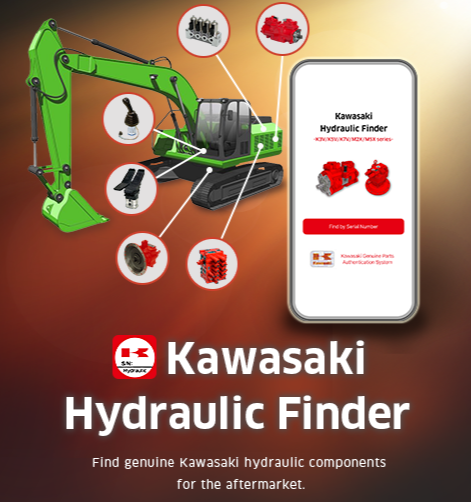
A dedicated app called “Kawasaki Hydraulic Finder” is useful for this process.
By simply entering the serial number from the nameplate, you can confirm whether a Kawasaki Heavy Industries component is genuine. If it is confirmed as genuine, accurate information such as the model code and part number will be displayed.
This helps prevent mistakes in parts identification and allows you to contact an authorized dealer more smoothly.
Summary: Understand Hydraulic Pump Types Correctly to Keep Construction Machinery in Service Longer
Hydraulic pumps, which serve as power sources for construction machinery, differ in their suitable pressure ranges and applications depending on type, including gear pumps, vane pumps, and piston pumps.
Understanding the characteristics and structure of each type improves the quality of routine maintenance and enables quick, accurate decisions if a failure occurs.
By properly managing hydraulic fluid to extend pump life and using the “Kawasaki Hydraulic Finder” app to arrange genuine parts when replacement is needed, you can support long-term stable operation.
Be sure to also check Kawasaki Heavy Industries service information and use it to improve efficiency at your jobsite.
Reviewed by

Ryoji Irie
Manager
After-Sales Promotion Office, Marketing & Sales Group, Precision Machinery & Robot Company, Kawasaki Heavy Industries, Ltd.
《Career History》
After joining Kawasaki Heavy Industries, I spent ten years developing the new K7V pump series as a design engineer, followed by five years at KPM (UK) as an application engineer supporting European OEMs and distributors. I am currently responsible for promoting the after-sales business globally.