Column
Hydraulic Pump Rebuild Guide: Process, Costs, Failure Causes, and Provider Selection
Are you experiencing sluggish hydraulic operation or unusual noises while operating construction machinery?
Problems with the pump can bring the entire machine to a stop, so early action is essential.
This article explains how hydraulic pumps work, the main causes of failure, and rebuilding methods such as using rebuilt units or performing an overhaul.
It also covers the risks of low-cost alternative parts and how to find an authorized service provider for repairs.
Use this guide to build the right maintenance knowledge and keep your machinery operating with confidence.
How Hydraulic Pumps Work and Their Main Types
To determine whether a hydraulic pump has a problem, it is important to first understand how it works.
Several types of hydraulic pumps are used in construction machinery, and each has different characteristics and suitable applications.
This section explains the basic role of a hydraulic pump from the following two perspectives.
- How mechanical energy is converted into pressure and flow
- The differences between gear, vane, and piston pumps and their applications
Understanding how each type works will make it easier to identify the likely cause of problems on site.
How Mechanical Energy Is Converted into Pressure and Flow
A hydraulic pump is a device that converts rotational energy generated by an engine or motor into fluid power.
It works by changing the volume of sealed internal chambers, drawing hydraulic fluid in and then pushing it out through the discharge port.
The movement of fluid created in this process becomes flow, and pressure is generated when that flow meets resistance in piping, cylinders, and other components.
Construction machinery can lift heavy soil or move forward with strong force because of this pressure and flow.
By applying Pascal’s principle, the hydraulic pump functions as an essential power source that allows large machines to be moved with relatively small input force.
Related Articles:How Hydraulic Systems Work Guide: Principles, Components, Troubleshooting, and Maintenance
The Differences Between Gear, Vane, and Piston Pumps and Their Applications
Hydraulic pumps used in construction machinery can mainly be divided into three types.
Because each type has a different mechanism and strengths, the appropriate pump is selected according to the performance required by the machine.
| Type | Mechanism | Features and strengths |
|---|---|---|
| Gear pump | Two meshing gears rotate to move hydraulic fluid | Simple structure, relatively low cost, and resistant to failure |
| Vane pump | Vanes pushed out by springs or centrifugal force move hydraulic fluid | Quiet operation and low pulsation |
| Piston pump | Multiple pistons move back and forth inside cylinders to discharge hydraulic fluid | Capable of generating high pressure and enabling precise control |
Piston pumps are especially common in large excavators and other machines that require high power, as they can handle high-pressure operation.
Related Articles:Hydraulic Pump Types Guide: Gear, Vane, and Piston Pumps for Construction Machinery
Main Causes and Symptoms of Hydraulic Pump Failure
When you notice an abnormality in a hydraulic pump on site, identifying the cause is the first step toward solving the problem.
This section explains three key points related to the signs that appear in the machine and the factors behind them.
- Typical symptoms such as insufficient pressure, oil leaks, and unusual noise
- External and internal causes of failure
- The role of the relief valve and the impact of valve problems
Understanding these symptoms and causes will help you avoid missing the right timing to request repairs.
Related Articles:Hydraulic Pump Failure: Common Causes, Symptoms, and Troubleshooting Tips
Typical Symptoms Such as Insufficient Pressure, Oil Leaks, and Unusual Noise
When a hydraulic pump develops a problem, clear signs often appear in the machine’s operation.
One common symptom is insufficient pressure, which may cause the boom to move slowly or the machine to lose its normal power.
Oil leaking from joints in the pump body or around the shaft is another serious symptom that should not be ignored.
In some cases, unfamiliar metallic noises or abnormal vibration may come from inside the pump.
These are warning signs of wear in internal gears or bearings, or deterioration of the hydraulic fluid.
If you notice even a slight change, inspect the machine and take action as soon as possible.
External and Internal Causes of Failure
Pump failures can generally be divided into external causes and internal causes.
Typical external causes include contamination of the hydraulic fluid and clogged filters.
When dust or metal particles enter the system, components rub against each other and the service life of the pump can be shortened significantly.
Internal causes include deterioration of seals over long periods of use and fatigue-related damage to components.
Operating the machine when the hydraulic fluid level or viscosity is not within the proper range can also cause serious damage to internal parts.
Many failures are caused by insufficient day-to-day maintenance, so regular oil changes and inspections are essential.
The Role of the Relief Valve and the Impact of Valve Problems
The relief valve is a safety valve that prevents pressure in the hydraulic circuit from exceeding the preset upper limit.
When abnormally high pressure occurs, it protects the entire system by diverting part of the hydraulic fluid back to the tank.
If this valve malfunctions, pressure may rise too high, potentially causing hoses to burst or the pump body to fail.
Conversely, if the valve remains open and does not close properly, the required pressure cannot be generated and the machine will not operate normally.
If abnormal pressure is suspected, check not only the pump body but also the operating condition of the relief valve.
The Difference Between Rebuilt Units and Overhauls, and How to Choose
When deciding on a repair approach, it is useful to compare several options.
By understanding the following two points, you can choose the method that best suits the situation.
- The definitions and differences between rebuilt units, overhauls, and replacement with a new unit
- The advantages and disadvantages of rebuilding
Choose the most appropriate method based on the condition of your machine and your budget.
The Definitions and Differences Between Rebuilt Units, Overhauls, and Replacement with a New Unit
There are three main options for repairing a hydraulic pump.
Each differs in terms of work scope, cost, and expected lead time.
| Method | Description | Features |
|---|---|---|
| Rebuilt unit | A used unit is disassembled and cleaned, deteriorated parts are replaced with new ones, and the unit is reassembled as a remanufactured product | Costs are often lower, and lead times tend to be shorter |
| Overhaul | The pump currently in use is removed, disassembled, and repaired in-house or by a specialist provider | Repairs can be tailored to the actual condition of the machine |
| Replacement with a new unit | A new part is ordered from the manufacturer and the entire unit is replaced | The most reliable option, but usually the most expensive |
Consider the best option based on your budget and how urgently the machine needs to be restored.
The Advantages and Disadvantages of Rebuilding
The main advantage of using a rebuilt unit or performing an overhaul is that repair costs can be reduced compared with purchasing a new unit.
Because many of the existing parts are reused, rebuilding can also help reduce environmental impact.
On the other hand, rebuilding may not be possible depending on the extent of damage to internal components.
Another concern is that the finished quality can vary depending on the technical capability of the service provider.
Choosing a provider based only on low cost can lead to trouble, so be sure to check warranty terms and past repair experience.
Hydraulic Pump Rebuilding Procedure
Specialist repair providers follow a strict process to rebuild hydraulic pumps while ensuring quality.
This section explains the actual workflow in the following four steps.
- Disassemble the pump and inspect the inside
- Clean, measure, and diagnose each component
- Replace parts and perform reconditioning work
- Reassemble the pump and test its performance
Understanding this process will make it easier to evaluate the repair estimate provided by a service provider.
Disassemble the Pump and Inspect the Inside
The rebuilding process begins with carefully disassembling the pump body.
First, external dirt is removed so that foreign matter does not enter the pump during disassembly.
As the pump is taken apart, it is standard practice to record in detail, using photos or other means, the order and orientation in which each component was installed.
It is also important to visually inspect gears, pistons, seals, and other components for abnormal wear or scratches.
Careful inspection at this early stage makes reassembly smoother and improves the accuracy of performance restoration.
This step is also essential for identifying the root cause of the failure.
Clean, Measure, and Diagnose Each Component
After disassembly is complete, all components are carefully washed with a dedicated cleaning solution to remove metal particles, old oil, and other contaminants.
Once the parts have been cleaned, each component is measured using precision instruments such as micrometers.
The measurements are then compared with the standard values specified by the manufacturer to determine whether wear remains within the allowable range.
Based on this diagnosis, parts are sorted into those that can be reused and those that should be replaced.
Accurate diagnosis that does not overlook minor wear helps stabilize the pump’s performance after repair and extends its service life.
Replace Parts and Perform Reconditioning Work
Once the diagnosis is complete, any parts judged to be defective are replaced, and reconditioning work is performed where appropriate.
Rubber consumable parts such as O-rings and oil seals should generally all be replaced with new ones, even if deterioration is not obvious from appearance alone.
If metal parts have minor scratches, polishing, coating, or other processes may be used to restore their original function.
For gears, bearings, and other components with severe wear, it is common to order and install genuine parts specified by the manufacturer.
The quality of the parts sourced and the precision of the reconditioning work performed at this stage largely determine the final quality of the rebuilt pump.
Reassemble the Pump and Test Its Performance
Once all parts are ready, the pump is carefully reassembled in a clean, dust-free environment.
Specialized tools are used to tighten bolts to the torque specified by the manufacturer, and great care is taken to prevent gaps or misalignment.
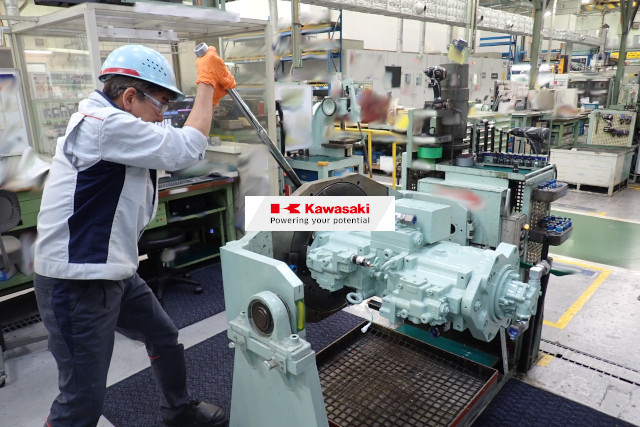
After assembly is complete, the pump is installed on a dedicated test bench and tested under loads close to actual operating conditions.
Pressure and flow rate are checked to confirm that they meet the required standards, and the pump is inspected for oil leaks and abnormal heat generation.
Only pumps that pass these strict tests are shipped as high-quality products ready to return to service on site.
Part Quality for Rebuilding and How to Choose a Repair Provider
When carrying out repairs, the quality of the parts used and the choice of service provider are major considerations.
If you make the wrong choice simply to reduce cost, you may end up shortening the service life of the machine.
This section focuses on the following two points.
- The risks that low-cost alternatives pose to machinery
- How to use “Kawasaki Hydraulic Finder” to verify genuine parts and find a repair contact
By understanding how to choose the right parts and service provider, you can build a safer operating system.
Related Articles:Hydraulic Pump Repair: Costs, Common Failure Causes, and Contractor Selection Guide
The Risks That Low-Cost Alternatives Pose to Machinery
In some cases, low-cost third-party, counterfeit, or imitation parts available on the market are selected to reduce repair costs.
However, even if they look similar to genuine parts, they often fall short in durability and dimensional accuracy.
Installing parts that do not meet the required standards can cause a drop in hydraulic pressure or oil leaks, and may even trigger a chain reaction that damages surrounding components that were previously functioning normally.
As a result, rework and long periods of downtime may occur, ultimately increasing the total cost.
To protect machine safety, it is essential to use parts with proven and assured quality.
How to Use “Kawasaki Hydraulic Finder” to Verify Genuine Parts and Find a Repair Contact
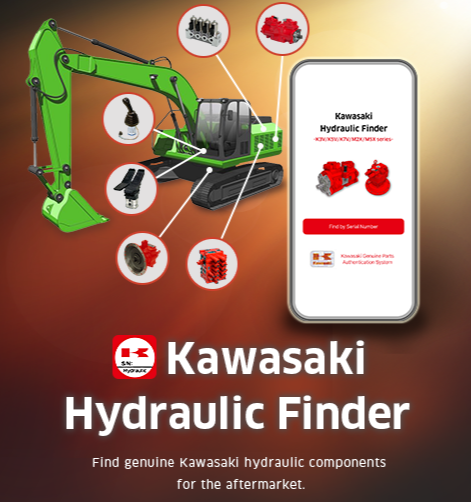
Kawasaki Heavy Industries’ dedicated app, “Kawasaki Hydraulic Finder,” is a useful tool for supporting parts selection.
By simply entering the serial number stamped on the pump nameplate into a smartphone, you can identify the manufacturer, exact product model, and product number.
If the component is confirmed to be genuine, accurate information such as the model code and part number will be displayed.
Using the displayed information, you can contact an authorized dealer, helping prevent mistakes in part numbers and making it easier to connect smoothly with a reliable repair contact.
Summary: Key Points to Consider When Deciding Whether to Rebuild a Hydraulic Pump
To use hydraulic pumps in construction machinery for as long as possible, it is important not to overlook warning signs of trouble and to respond early.
If you notice reduced pressure or unusual noise, stop work and inspect the machine immediately.
Using a rebuilt unit or performing an overhaul can restore performance at a lower cost than replacing the pump with a new unit.
To avoid problems caused by low-cost alternative parts, use dedicated apps and other tools to arrange genuine parts, and request repairs from a service provider you can trust.
By carrying out careful maintenance on a regular basis, you can help keep your machinery operating reliably.
Reviewed by

Ryoji Irie
Manager
After-Sales Promotion Office, Marketing & Sales Group, Precision Machinery & Robot Company, Kawasaki Heavy Industries, Ltd.
《Career History》
After joining Kawasaki Heavy Industries, I spent ten years developing the new K7V pump series as a design engineer, followed by five years at KPM (UK) as an application engineer supporting European OEMs and distributors. I am currently responsible for promoting the after-sales business globally.