Column
Hydraulic Piston Pump Guide: Structure, Types, Operating Principles, and Failure Signs
Are you wondering how a hydraulic piston pump works, or how to decide whether it should be repaired or replaced when you suspect a failure?
Hydraulic piston pumps are essential power sources for construction machinery and many other types of equipment. However, because their structure is complex, it is not always easy to decide how to maintain or repair them.
This article explains the different types of hydraulic pumps, how piston pumps work, and the warning signs of failure.
It also covers how to check compatibility with genuine parts before repair, so use it as a practical reference.
Types of Hydraulic Pumps
A hydraulic pump is a device that delivers hydraulic fluid to transmit power.
Based on differences in structure, hydraulic pumps can generally be divided into three types.
To better understand the characteristics of piston pumps, it helps to first compare them with other pump types.
By understanding how each type works and what its strengths are, you can more easily choose the right pump for your application.
- Gear pumps
- Vane pumps
- Piston pumps
Let’s look at the characteristics of each type in turn.
Gear Pumps
A gear pump draws in and discharges hydraulic fluid by rotating two meshing gears.
Because the structure is simple and the number of parts is small, gear pumps are generally less expensive than other types and are relatively resistant to failure.
They can also operate even when the hydraulic fluid contains a certain amount of contamination, so they require less maintenance.
On the other hand, they are not well suited to generating very high pressure and can be relatively noisy during operation.
Gear pumps are commonly used to provide stable power in applications that do not require high pressure, such as agricultural machinery and small construction equipment.
Vane Pumps
A vane pump has a rotor inside a cylindrical housing, with multiple blades called vanes mounted on the rotor.
As the rotor turns, centrifugal force and hydraulic pressure, or back pressure, push the vanes outward against the inner wall of the housing. The vanes then slide along the wall and push out hydraulic fluid.
Because the components move smoothly, vane pumps are known for quiet operation and low vibration.
They also provide a stable discharge flow, making them common in industrial machinery that requires smooth movement.
However, compared with gear pumps, their structure is more complex. If the hydraulic fluid is contaminated, the vanes may not move smoothly, so careful day-to-day fluid management is important.
Piston Pumps
A piston pump draws in hydraulic fluid and discharges it at high pressure by moving pistons back and forth inside cylinders.
It can generate high pressure and can also be designed as a variable displacement pump, allowing the amount of fluid delivered per stroke to be finely controlled.
Its structure offers excellent sealing performance with minimal leakage, and its high energy conversion efficiency allows power to be transmitted with little waste.
Piston pumps are high-performance pumps used in a wide range of applications, from excavators and cranes that require powerful force to industrial equipment that demands precise control.
Related Articles:Hydraulic Pump Components Guide: Main Parts, Functions, and Failure Response
What Is a Hydraulic Piston Pump? Structure and Operating Principle
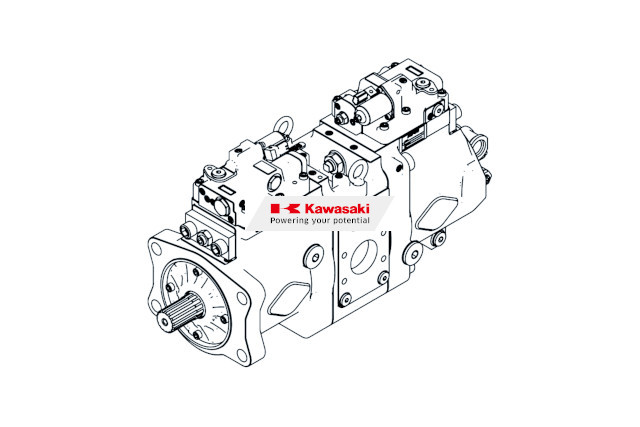
A hydraulic piston pump is a device that contains multiple pistons inside a component called a cylinder block.
When a shaft rotates using power from a motor or other drive source, the pistons inside move back and forth within the cylinders.
The basic principle is simple: when the piston retracts, it draws hydraulic fluid in from the tank; when it moves forward, it pushes the fluid out into the system with strong force.
It may be easiest to picture the movement of a syringe plunger being pulled and pushed continuously in a circular motion.
Because the internal clearances are very small, a hydraulic piston pump can discharge high-pressure fluid efficiently.
Types of Hydraulic Piston Pumps
Hydraulic piston pumps come in several designs depending on the arrangement and movement of the pistons.
Below are four representative types commonly seen on construction sites and in factories.
- Swash plate type
- Bent-axis type
- Radial piston type
- Reciprocating type
Understanding how each type works and where it performs best will help you better understand the specifications of the equipment you use.
Swash Plate Type
In a swash plate pump, the pistons are arranged parallel to the shaft, and the ends of the pistons press against an angled plate called a swash plate.
As the shaft rotates, the angle of the swash plate pushes and pulls the pistons, continuously discharging hydraulic fluid.
A key advantage of this design is that the discharge flow can be adjusted easily by changing the angle of the swash plate.
Because the overall structure can be made compact, swash plate pumps are widely used as hydraulic power sources in construction machinery and industrial vehicles where space is limited.
They provide stable power across a wide range of jobsite applications.
Related Articles:Variable Displacement Pump Guide: Structure, Working Principles, Pressure Adjustment, and Maintenance
Bent-Axis Type
A bent-axis pump has a structure in which the entire cylinder block is positioned at an angle relative to the shaft.
As the shaft rotates, the cylinder block rotates with it while the pistons move back and forth.
Compared with the swash plate type, the bent-axis type offers better suction performance and can withstand higher rotational speeds.
Because less lateral force is applied to the pistons, wear is reduced and power can be transmitted efficiently.
Bent-axis pumps are often chosen for large construction machinery and heavy equipment that operate in demanding environments and require high pressure and strong force. They are robust and highly reliable hydraulic pumps.
Radial Piston Type
A radial piston pump has pistons arranged radially around the shaft, like the spokes of a wheel.
As a central cam rotates, it pushes the surrounding pistons outward one after another, continuously discharging hydraulic fluid.
Because the piston movement is direct and force is less likely to escape, this type can generate even higher pressure than swash plate or bent-axis pumps.
It can produce strong, stable force even at low rotational speeds, making it suitable for industrial machinery that applies high force slowly and steadily, such as plastic injection molding machines and large presses.
Reciprocating Type
A reciprocating pump converts rotary motion from a crankshaft or similar mechanism into linear motion, moving a small number of pistons back and forth in a straight line.
Unlike other types, where multiple pistons rotate together with the cylinder block, each piston moves linearly, much like the piston in an engine.
This type has a robust structure and is well suited to generating extremely high pressure.
Although it is not often used as the main pump in construction machinery, it may be used in high-pressure testing equipment or specialized industrial applications where stable high pressure is required.
Advantages and Disadvantages of Hydraulic Piston Pumps
When considering the adoption or replacement of a hydraulic piston pump, it is important to understand both its strengths and the points that require caution.
The main advantage is that it can generate high pressure while transmitting power efficiently.
Because the discharge volume of hydraulic fluid can be finely adjusted, piston pumps are also highly versatile and can be used in a wide range of applications.
On the other hand, their complex structure means the pump itself tends to be more expensive.
They are also sensitive to contamination in the hydraulic fluid, which can easily damage internal components. For this reason, regular maintenance is essential.
Warning Signs and Causes of Hydraulic Piston Pump Failure
If a hydraulic pump suddenly stops working, the entire machine may come to a halt.
To prevent failure, it is important to notice the following three changes as early as possible.
- Oil leaks
- Reduced hydraulic pressure
- Unusual noise or vibration
Do not overlook these signs that can be detected on site. Identifying the underlying cause early will help you take prompt corrective action.
Oil Leaks
If hydraulic fluid is seeping from the pump body or hose connections, it is a sign of an oil leak.
Even a small leak can reduce the hydraulic fluid level if left unaddressed, allowing air to enter the entire system and potentially leading to serious failure.
The main cause is age-related deterioration of internal packings and rubber sealing components, which can harden or crack over time.
In some cases, seals may also fail because they are continuously exposed to pressure above the specified level.
Make it a habit to check daily for oil pooling under the machine, and inspect the pump immediately if you notice anything unusual.
Reduced Hydraulic Pressure
If the machine seems to be moving more slowly than usual, hydraulic pressure may be dropping.
Possible causes include the pump not delivering enough hydraulic fluid or fluid leaking internally inside the pump.
This often occurs when long-term use wears the pistons or cylinder block, allowing oil to leak through the clearances that have formed.
Hydraulic pressure may also fail to hold if the hydraulic fluid temperature rises too high and the fluid loses viscosity.
If you notice a decline in work efficiency, do not force the machine to continue operating. Ask a specialist service provider to inspect the internal wear condition of the pump.
Related Articles:Hydraulic Pump Not Building Pressure? Causes, Troubleshooting Steps, and Repair Costs
Unusual Noise or Vibration
Be careful if the pump produces a dull, abnormal sound or unusually strong vibration during operation.
In many cases, the cause is air mixed into the hydraulic fluid.
This can occur when the suction-side filter is clogged or the fluid level is too low. The resulting condition can subject internal metal components of the pump to severe impact and may lead to failure.
Other possible causes include bearing wear or early signs of seizure between internal components.
If you notice unusual noise, stop the machine immediately and check the hydraulic fluid level and filter contamination so you can respond quickly.
How to Decide Whether to Repair or Replace a Hydraulic Piston Pump
When a pump develops a problem, deciding whether to repair it or replace it with a new unit can be difficult on site.
As a general guideline, if the issue is limited to packing replacement or minor wear of small components, repair will usually help reduce costs.
However, if major metal components such as cylinders or shafts have seized, repair costs can become high, making replacement the more appropriate option.
The amount of downtime your site can tolerate is also an important factor.
If delivery time is critical, replacing the entire unit with a warrantied remanufactured pump may also be a good option.
Consider both the severity of the symptoms and the balance of cost, then choose the response that best fits the situation at your site.
Related Articles:Hydraulic Pump Rebuild Guide: Process, Costs, Failure Causes, and Provider Selection
Check Genuine Parts and Compatibility Before Repair
When arranging parts for a hydraulic pump, choosing low-cost third-party, counterfeit, or imitation parts may lead to unexpected problems.
To proceed safely with repair work, follow the three steps below.
- Check the model and part number
- Confirm whether the part is genuine
- Decide where to seek advice
Choosing the right parts and using authorized support channels will help extend the service life of your machine.
Check the Model and Part Number
The first step before repair or parts replacement is to identify the exact model and part number of the pump installed on the machine. Even on construction machinery from the same manufacturer, hydraulic pump specifications often differ depending on the production period or optional equipment.
Start by locating the metal nameplate attached to the pump body and reading the serial number or model code stamped on it.
Keeping a record of this number allows a dealer or manufacturer to arrange the correct parts quickly and accurately when you make an inquiry.
Confirm Whether the Part Is Genuine
It is also essential to confirm that the parts you are arranging are genuine parts specified by the manufacturer.
The market contains many look-alike alternatives, but these often do not meet the pressure and durability standards assumed by the manufacturer.
Using parts that do not meet the required standards may cause the pump itself to fail quickly. Metal particles generated by wear may also spread to surrounding equipment and damage it.
To draw out the machine’s intended performance and continue using it safely on site, choose quality-assured genuine parts.
Decide Where to Seek Advice
Even after identifying the model, you may still be unsure which parts are required. In that case, it is important to find a reliable place to consult.
The most reliable option is to contact an authorized service center or dealer certified by the pump manufacturer.
An authorized contact point can use a dedicated system to identify the correct parts from the serial number.
They can also provide technical advice, such as whether the pump should be repaired or replaced as a complete unit, rather than simply selling parts.
To reduce machine downtime, consult a specialist early and get the right support.
Summary: Key Points for Properly Maintaining and Operating a Hydraulic Piston Pump
Hydraulic piston pumps offer excellent performance, including high pressure capability and precise control. At the same time, they have a complex structure and are sensitive to contamination in the hydraulic fluid.
To avoid stopping work on site, do not overlook small warning signs such as oil leaks or unusual noise. Early maintenance and inspection are essential.
If repair or parts replacement becomes necessary, check the serial number on the pump body nameplate and choose genuine parts.
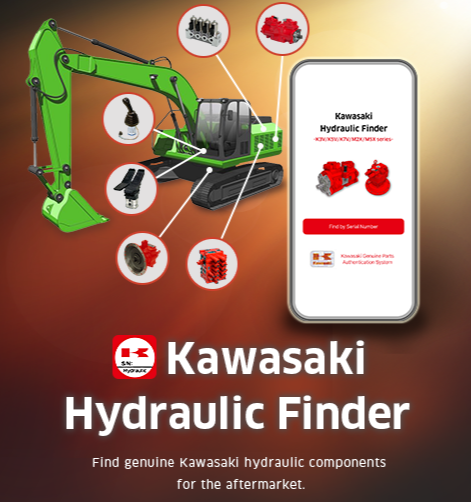
By using Kawasaki Heavy Industries’ “Kawasaki Hydraulic Finder,” you can identify the manufacturer, exact product model, and product number from the serial number on the nameplate.
If the part is confirmed as genuine, accurate information such as the model code and part number will be displayed, allowing you to contact an authorized dealer more smoothly.
By choosing the right parts and carrying out inspections early, you can operate your construction machinery safely for longer.
Reviewed by

Ryoji Irie
Manager
After-Sales Promotion Office, Marketing & Sales Group, Precision Machinery & Robot Company, Kawasaki Heavy Industries, Ltd.
《Career History》
After joining Kawasaki Heavy Industries, I spent ten years developing the new K7V pump series as a design engineer, followed by five years at KPM (UK) as an application engineer supporting European OEMs and distributors. I am currently responsible for promoting the after-sales business globally.